Convert English to Morse Code Free — Words, Phrases and Common Messages
You want to convert English to morse code but do not want to memorize a chart or spend an hour figuring out the rules. You just want the answer.
Type any word, sentence, or phrase into the morse code text converter above. The tool converts it to dots and dashes instantly using the ITU-R M.1677-1 international standard. Copy the result, download it, play the audio, or share it directly. No login needed and nothing you type is stored.
This article gives you the most searched English to morse code conversions all in one place — common greetings, emotional phrases, emergency signals, and a complete guide on how the encoding process works. Whether you need it for a tattoo, a bracelet engraving, a puzzle, a school project, or a HAM radio session, every conversion here follows the official ITU standard.
How to Convert English to Morse Code
Converting English text to morse code follows a simple and consistent system. Every letter in the Latin alphabet, every number from 0 to 9, and all common punctuation marks map to a unique dot-dash sequence defined by the ITU-R M.1677-1 standard.
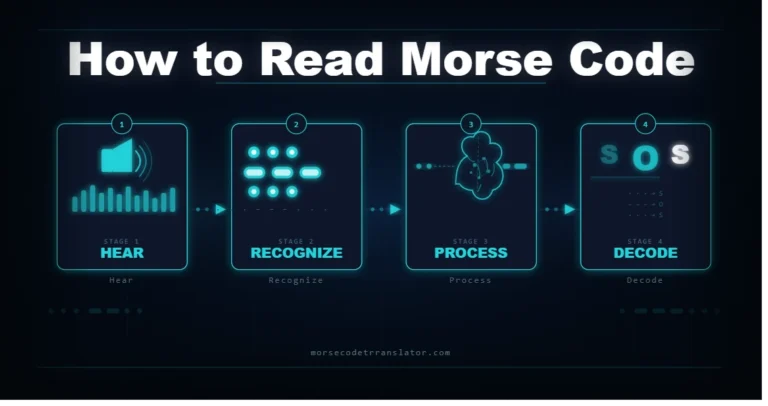
The conversion process works like this:
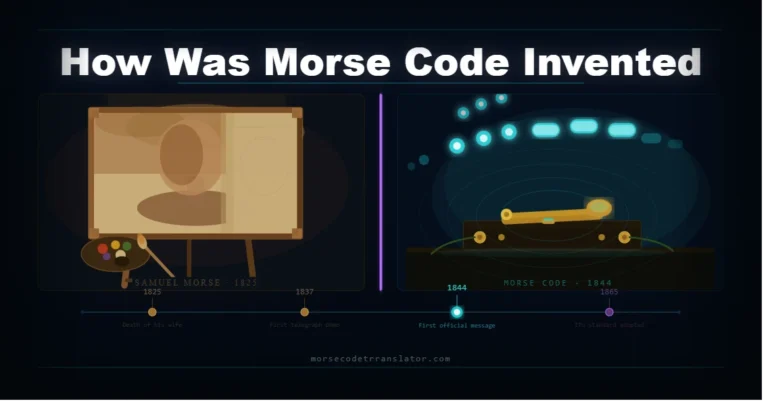
Alfred Vail and Samuel Morse designed the system so the most common English letters get the shortest codes. E is a single dot. T is a single dash. This kept telegraph messages fast to encode and transmit.
Hello in Morse Code and Common Greetings
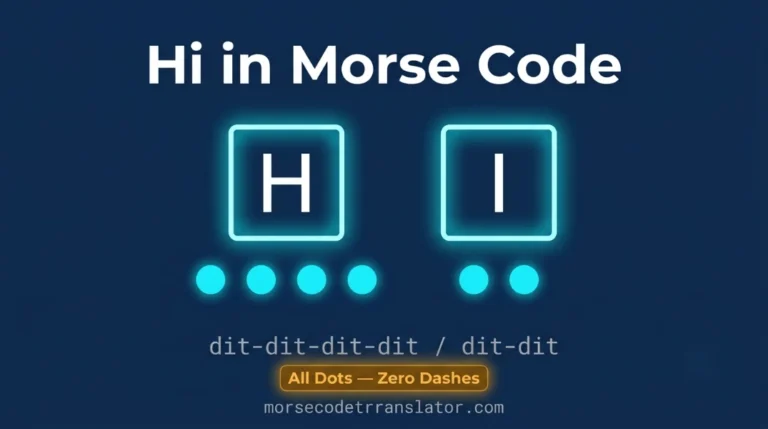
Greetings are the most searched morse code conversions online. Learning to convert hello and hi into morse code also teaches you five of the most common letters in the English language — H, E, L, O, and I.
Common Greetings Converted
Phrase | Morse Code |
Hi | . . . . / . . |
Hello | . . . . / . / . — . . / . — . . / — — — |
Good morning | — — . / — — — / — . . / — — — — — / — — / — — — / . — . / — . / . . / — . / — — . |
Good night | — — . / — — — / — . . / — — — — — / — . / . . / — — . / . . . . / — |
Thank you | — / . . . . / . — / — . / — / — . — — / — — — / . . — |
Learning through real phrases beats memorizing the alphabet in order. The phrase “Hello” alone teaches you H, E, L, and O — four of the most common English letters — in a context that sticks.
I Love You in Morse Code and Personal Phrases
Personal and emotional phrases are among the most searched morse code conversions worldwide. People use them for jewelry engravings, tattoos, handwritten notes, and creative gifts. A morse code message is private by default — only someone who knows the system can read it.
I Love You in Morse Code
.. / .-.. — …- . / -.– — ..-
Word | Morse Code |
I | . . |
LOVE | . — . . / — — — / . . . — / . |
YOU | — . — — / — — — / . . — |
Popular Personal Phrases
Phrase | Morse Code |
I love you | . . / . — . . / — — — / . . . — . / — . — — / — — — / . . — |
I miss you | . . / — — / . . . / . . / — . — — / — — — / . . — |
Be safe | — . . . / . / . . . / . — / — — — — . / . |
Stay strong | . . . / — / . — / — . — — / . . . / — / — . — . / — — . / — — — |
Forever | — — — — . / — — — / . — . / . — . . / . . . — / . . — |
Always | . — / . — . . / .— . — — . / . . . / — . — — |
Many people incorporate morse code into jewelry, bracelets, and tattoos. The message looks like a pattern of dots and dashes to anyone who does not know morse code but carries full meaning for the person who receives it.
Yes, No, Help and Emergency Phrases in Morse Code
Short, high-use words are the fastest to learn and the most practical to know. These are the conversions people search for most after greetings and personal phrases.
Short Words Converted
Word | Morse Code |
Yes | — . — — / . / . . . |
No | — . / — — — |
OK | — — — / — . — |
Help | . . . . / . / . — . . / . — — . |
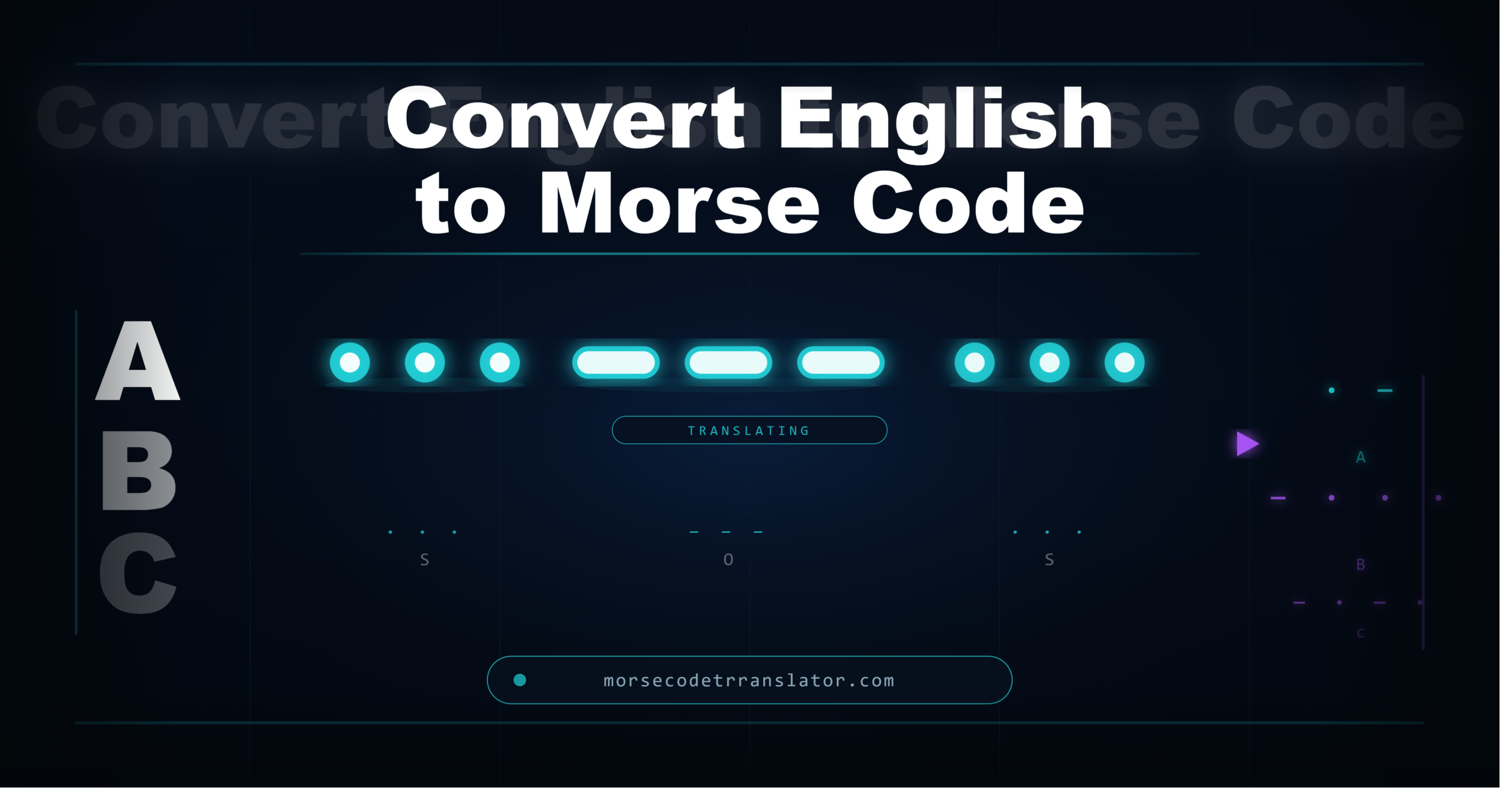
SOS | . . . — — — . . . |
SOS is not just another word in morse code. It is the universal distress signal recognized by every maritime authority, military force, and rescue service worldwide. Unlike regular words, SOS transmits as one unbroken block with no gaps between letters. Three dits, three dahs, three dits. Impossible to confuse with anything else on a radio frequency.
Knowing how to tap, flash, or signal SOS and HELP without any device is a real survival skill. When every other communication method fails, this nine-signal pattern can save your life.
How Morse Code Words Work — The Encoding Rules
Understanding the encoding rules helps you convert any English text accurately without relying on a tool. Once you know the system, you can encode any word from memory.
The core rules every encoder follows:
Why some letters are shorter than others
The ITU encoding system is not random. Alfred Vail assigned shorter codes to letters that appear more often in English text. The result is a frequency-weighted system that keeps common English messages fast to send.
The most common English letters get the shortest codes — E is one dot, T is one dash, I is two dots. Rare letters like Q and Z get longer codes because they appear far less often in everyday English text.
Copy and Paste Morse Code — Using Your Conversions
The tool above gives you several ways to use your converted morse code output.
The core rules every encoder follows:
Frequently Asked Questions
Convert Any English Text to Morse Code Right Now
The converter above handles every letter from A to Z, every number from 0 to 9, and all standard punctuation marks. Type your message, get the morse code output, and copy it in one click.
Use it for personal messages, jewelry engravings, creative projects, HAM radio practice, escape room puzzles, or simply to learn how english to morse code conversion works. Every result follows the ITU-R M.1677-1 international standard — the same standard used by radio operators, maritime services, and aviation navigation systems worldwide.
If you want to go the other direction and decode a morse code string back into English, visit our Online Morse Code Decoder page.