Numbers in Morse Code — The Complete 0 to 9 Chart and Pattern Guide
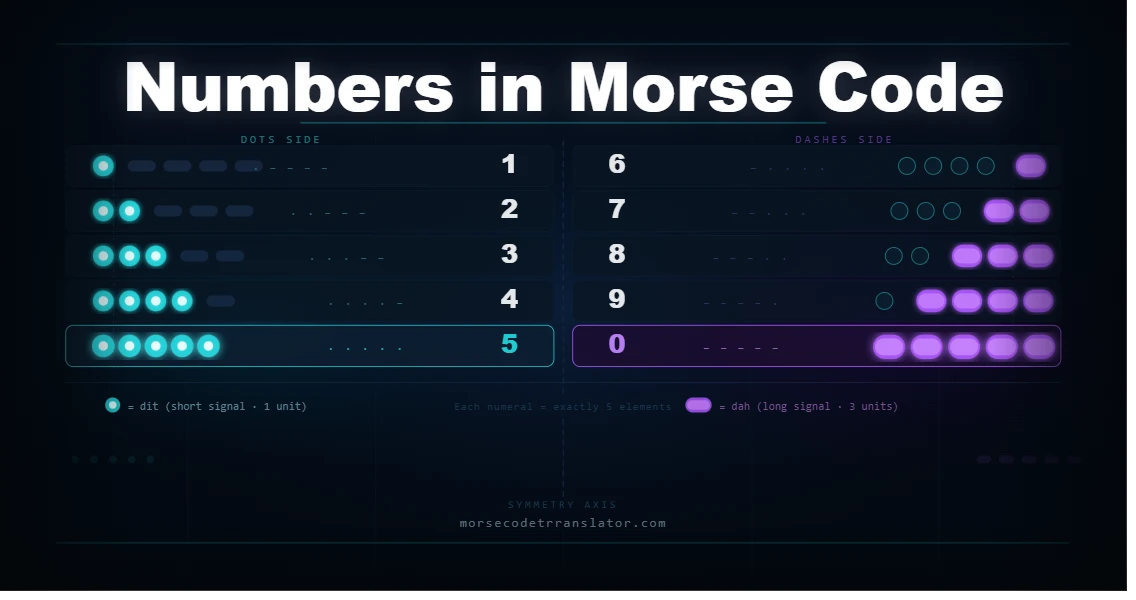
Numbers in morse code work differently from letters. While letters use one to four signals per character, every single digit from 0 to 9 uses exactly five signals. No exceptions. This consistency is what makes the number system one of the most logical and learnable parts of the entire ITU morse code standard.
This guide gives you the complete numbers in morse code chart, explains the pattern logic that lets you memorize all ten digits in minutes, shows how to encode real-world numbers like dates and phone numbers, and explains where numeric morse code is still used today. All patterns follow the ITU-R M.1677-1 standard.
Use the morse code translator on this platform to hear any number at your chosen WPM and pitch.
The Complete Morse Code Numbers Chart — 0 to 9
Every digit from 0 to 9 maps to a unique five-signal dot-dash pattern in the ITU-R M.1677-1 standard. The five-signal standardization means a trained operator can decode numbers at consistent speed regardless of which digit is being sent.
Complete 0 to 9 Reference Chart
Number | Morse Code | Signal Count | Pattern Type |
0 | — — — — — | 5 dahs | All dashes |
1 | . — — — — | 1 dit + 4 dahs | Starts with 1 dot |
2 | . . — — — | 2 dits + 3 dahs | Starts with 2 dots |
3 | . . . — — | 3 dits + 2 dahs | Starts with 3 dots |
4 | . . . . — | 4 dits + 1 dah | Starts with 4 dots |
5 | . . . . . | 5 dits | All dots |
6 | — . . . . | 1 dah + 4 dits | Starts with 1 dash |
7 | — — . . . | 2 dahs + 3 dits | Starts with 2 dashes |
8 | — — — . . | 3 dahs + 2 dits | Starts with 3 dashes |
9 | — — — — . | 4 dahs + 1 dit | Starts with 4 dashes |
This chart follows ITU-R M.1677-1 as maintained by the International Telecommunication Union. Every HAM radio operator, maritime service, and CW transmitter worldwide uses these same ten patterns.
The Dot-Dash Pattern Logic — How to Memorize All 10 Numbers Instantly
This is what the competitor’s article misses entirely. You do not need to memorize ten separate patterns. You only need to understand one rule.
The digits 1 through 5 begin with dots and progressively replace them with dashes. The digits 6 through 0 do the exact opposite — starting with dashes and replacing them with dots.
Here is what that looks like visually:
1 to 5: Building dots from left to right
Number | Pattern | How to See It |
1 | . — — — — | One dot then four dashes |
2 | . . — — — | Two dots then three dashes |
3 | . . . — — | Three dots then two dashes |
4 | . . . . — | Four dots then one dash |
5 | . . . . . | Five dots — the midpoint |
6 to 0: Building dashes from left to right
Number | Pattern | How to See It |
6 | — . . . . | One dash then four dots |
7 | — — . . . | Two dashes then three dots |
8 | — — — . . | Three dashes then two dots |
9 | — — — — . | Four dashes then one dot |
0 | — — — — — | Five dashes — the endpoint |
This pattern makes all ten digits memorizable in seconds once you understand the rule. The number 5 is the exact midpoint — five dots. Everything from 1 to 4 adds one dash per step. Everything from 6 to 0 adds one more dash per step in the other direction.
There is mirror symmetry in the number system. According to universalalphabet.com, digit 1 (.—-) mirrors 6 (-….), 2 mirrors 7, 3 mirrors 8, 4 mirrors 9, and 5 mirrors 0. Learning one side of the mirror gives you the other for free. One important warning: if you drop one dash from 1, it collapses into J. This is why the five-signal rule is worth locking in early.
How to Encode Numbers in Morse Code Correctly
Encoding numbers follows the same spacing rules as letters. Treat each digit as its own five-signal unit with a letter gap between digits.
The encoding rules:
Worked encoding examples:
Number | Morse Code | How to Read It |
7 | — — . . . | Two dashes then three dots |
42 | . . . . — / . . — — — | 4 then 2 separated by slash |
123 | . — — — — / . . — — — / . . . — — | 1 then 2 then 3 |
2025 | . . — — — / — — — / . . — — — / . . . . . | 2 then 0 then 2 then 5 |
911 | — — — — . / . — — — — / . — — — — | 9 then 1 then 1 |
At 17 WPM each digit takes roughly 1.5 seconds including inter-signal gaps. At 5 WPM the same digit stretches to about 4.5 seconds. Speed matters when encoding long sequences like GPS coordinates.
Real-World Numbers in Morse Code — Practical Encoding Examples
Morse code numbers are not just for practice drills. They appear constantly in real communication systems and everyday creative use.
Encode your phone number
Encode a date
Date | Morse Encoding |
June 20 (6/20) | — . . . . / . . — — — / — — — — — |
Year 2026 | . . — — — / — — — / . . — — — / — . . . . |
1844 (first telegraph) | . — — — — / — — — — . / . . . . — / . . . . — |
Personal encoding
Why Every Number Uses Five Signals — The History Behind the Standard
The five-signal rule was not arbitrary. It was a deliberate engineering decision with a specific purpose.
Samuel Morse and Alfred Vail’s original 1840s telegraph code encoded digits unevenly. Some used internal pauses, others used extra-long dashes worth six time units. When the International Morse Code was standardized in 1865 for continental telegraph networks, the numbers were rebuilt. Every digit became exactly five signals, a clean staircase from .—- to —–.
The five-signal standard solved three problems. It made every digit take the same transmission time. It eliminated ambiguity since no letter uses five signals. And it made the system learnable through pattern logic. According to morse-coder.com, the consistent five-signal pattern was chosen for clarity and resistance to transmission errors over long distances.
How to Practice Numbers in Morse Code — A Daily Routine That Works
Learning morse code numbers is faster than learning the letters because the pattern logic gives you a framework. Use this daily structure for the fastest results.
Start with 5 (five dots), 0 (five dashes), and 1 (one dot then four dashes). These three anchor the entire system. Then practice mirror pairs: 1 and 6, 2 and 7, 3 and 8, 4 and 9. Learning one side of each pair reinforces the other automatically.
Practice three five-minute sessions daily. Morning: listen to digits 0 to 9 in random order. Afternoon: encode your phone number or today’s date from memory. Evening: run a decode quiz using audio playback. Use the translator on this platform at 15 WPM — fast enough to train sound recognition rather than visual counting. Most learners recognize all ten digits reliably within ten days.
Frequently Asked Questions
Convert Any Number to Morse Code Right Now
Numbers in morse code follow one of the most logical patterns in the ITU-R M.1677-1 system. Every digit uses exactly five signals. The staircase from 1 to 5 builds dots, from 6 to 0 builds dashes. Mirror pairs give you both sides from half the effort.
Type any number, date, phone number, or coordinate into the morse code translator on this platform for instant encoded output with audio playback. For the complete letter reference, visit our Morse Code Alphabet page. For encoding full phrases, visit our Convert English to Morse Code guide.