Yes in Morse Code — The Exact Pattern, Sound, Tap and Complete Guide
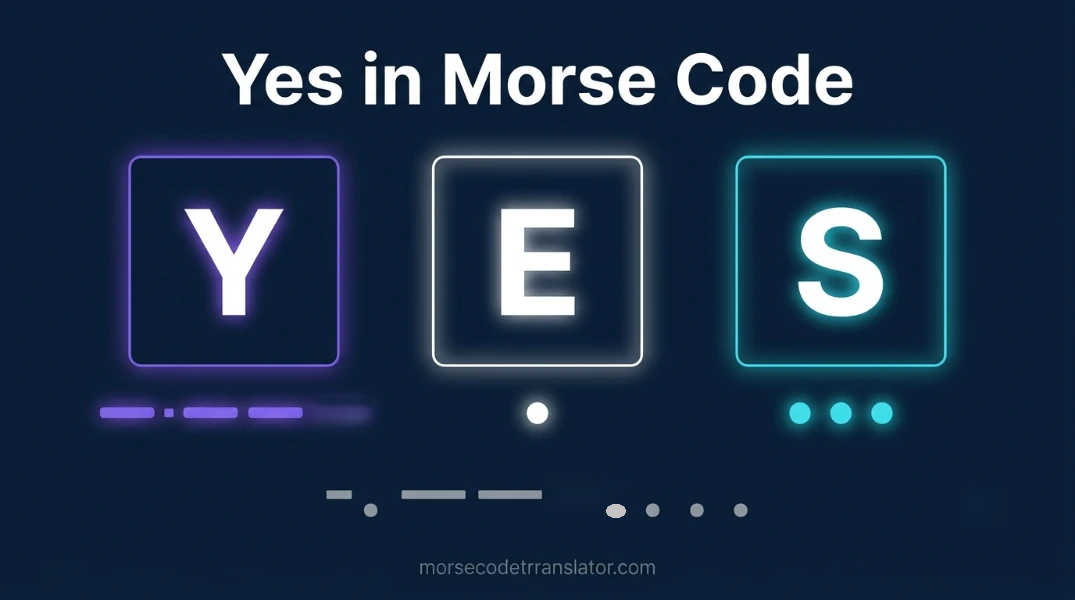
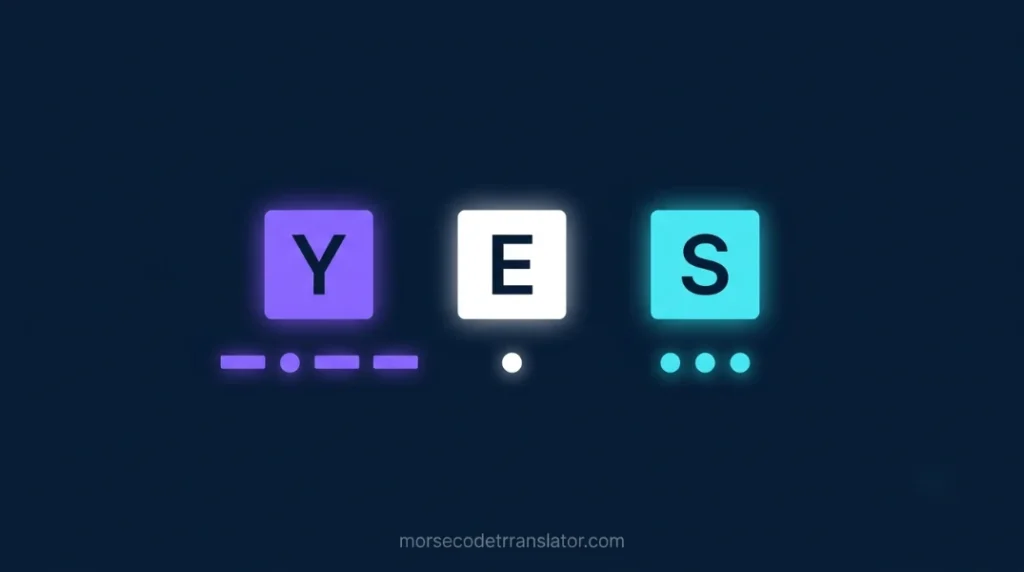
Yes in morse code is — . — — . . .
Three letters. Nine signals. One of the most useful words you can learn to send without speaking.
This guide gives you the full letter-by-letter breakdown, the spoken dit-dah sequence, how to tap it, flash it, blink it, the yes and no in morse code comparison, yes sir in morse code, and how YES is used in real military and radio communication — all in one place.
Every pattern follows the ITU-R M.1677-1 international standard. Use the free morse code translator on this platform to hear YES played back as audio tones at your chosen WPM.
What Is Yes in Morse Code — The Exact Pattern
Yes uses three letters: Y, E, and S. Each has a different character in the ITU alphabet.
Letter | Morse Code | Signal Type | Spoken Sound |
Y | — . — — | 1 dash, 1 dot, 2 dashes | dah-dit-dah-dah |
E | . | 1 dot | dit |
S | . . . | 3 dots | dit-dit-dit |
Full word: — . — — . . .
Copy and paste format: -.– . …
Spoken out loud: dah-dit-dah-dah / dit / dit-dit-dit
Total signals: 9 across 3 letters
Why Y is the most complex letter
Y uses four signals. It mixes dashes and dots in a specific order — dash, dot, dash, dash.
It is the only letter in YES that uses both signal types. E is just one dot. S is three dots in a row.
This makes YES self-checking. If your Y ends in two long signals, your E is one quick tap, and your S finishes with three quick taps — the word is correct.
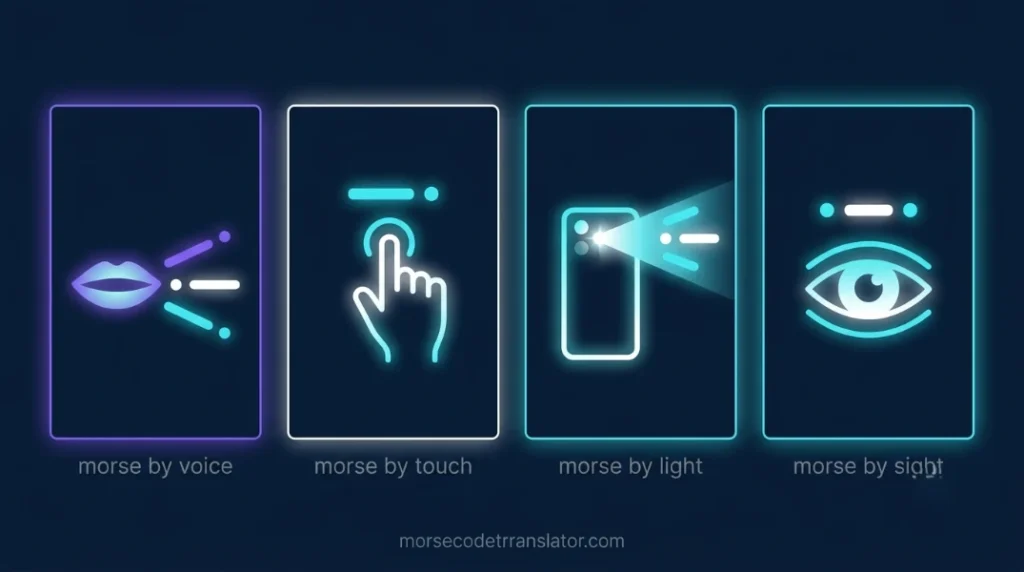
How to Say Yes in Morse Code — Four Methods
Method 1 — Say It Out Loud
Morse code operators use “dit” for dots and “dah” for dashes. The words match the actual tone sounds.
Speak YES like this:
Full sequence: dah-dit-dah-dah / dit / dit-dit-dit
Pause briefly between letters. This vocal method is how HAM radio operators internalize each letter as a complete sound rather than counting individual signals.
Method 2 — How to Tap Yes in Morse Code
Short taps are dots. Long holds are dashes.
Letter | Tap Pattern | Signals |
Y | hold-tap-hold-hold | 4 |
E | tap | 1 |
S | tap-tap-tap | 3 |
At 15 WPM:
Method 3 — How to Flash Yes in Morse Code
Short flashes are dots. Long flashes are dashes.
Flash sequence for YES:
Keep short flashes under half a second. Hold long flashes for one to one and a half seconds. Works with any light source — phone torch, handheld flashlight, signal mirror.
Method 4 — How to Blink Yes in Morse Code
Short blinks are dots. Long blinks are dashes.
Blink sequence:
Blinking is the most discreet method. U.S. Navy Commander Jeremiah Denton blinked the word TORTURE in morse code during a televised interview in 1966 while a prisoner of war in North Vietnam. According to Military.com, his captors had no idea he was sending a hidden message to American intelligence.
Yes and No in Morse Code — Side by Side
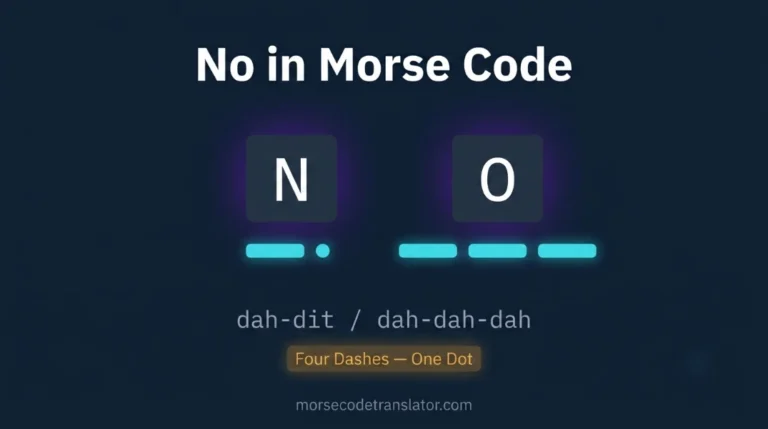
Learning yes and no in morse code together is more efficient than learning either word alone.
Word | Morse Code | Signals | Letters |
Yes | — . — — . . . | 9 | Y + E + S |
No | — . — — — | 7 | N + O |
OK | — — — — . — | 8 | O + K |
Correct | — . — . — . — . — . | 15 | C+O+R+R+E+C+T |
YES and NO are completely different in pattern. They cannot be confused in transmission.
According to Wikipedia’s article on Procedure Words, the U.S. Navy instructs sailors to use the plain words “yes” and “no” over poor quality connections rather than “affirmative” and “negative” — because the longer words can be mistaken for each other. In morse code this problem disappears entirely.
Radio Shorthand — Yes and No Without Spelling Them Out
In HAM radio CW operation, operators use single-letter alternatives for speed:
Signal | Meaning | When Used |
C | Correct or yes | Sent after a Q-code question |
N | No or incorrect | Sent after a Q-code question |
R | Received and understood | Equivalent to roger |
K | Go ahead | Invitation to transmit |
According to Wikipedia’s article on Q-codes, sending C immediately after a Q-code gives it an affirmative meaning. Sending N gives it a negative meaning. This shorthand was used across maritime, military, and amateur radio networks worldwide.
Yes Sir in Morse Code
Yes sir encodes across two words: YES and SIR.
Letter | Morse Code |
Y | — . — — |
E | . |
S | . . . |
S | . . . |
I | . . |
R | . — . |
Full pattern: -.– . … / … .. .-.
Spoken: dah-dit-dah-dah / dit / dit-dit-dit / dit-dit-dit / dit-dit / dit-dah-dit
SIR adds three more letters after YES. S is three dots. I is two dots. R is dot-dash-dot. In formal military radio communication, confirmation phrases like “yes sir” were standard procedure before prowords like “wilco” and “roger” became the universal standard across NATO and allied forces.
Where YES Is Used in Real Morse Code Communication
YES is not just a practice word. It has served real communication across military operations, amateur radio, and emergency signaling.
Military Communication
During World War II, operators confirmed orders using short morse words to cut transmission time and reduce interception risk.
According to Britannica’s article on military communication, morse code was essential in rapidly moving field armies. Telephone and telegraph lines could not keep up. Short confirmations like YES saved critical time.
The U.S. Navy still trains cryptologic technicians in morse code. According to In Compliance Magazine, the Basic Manual Morse Trainer course teaches sailors to intercept, copy, and send morse code — including confirmation signals.
HAM Radio Practice
Amateur radio operators use YES during CW practice sessions.
The word sits at a comfortable 15 WPM practice level. Long enough to test timing. Short enough to send without errors. Most CW training programs introduce YES within the first few sessions after learners master individual letters.
Emergency Signaling
In survival situations, YES confirms safety, location, or understanding without requiring voice.
A rescue team tapping a wall and receiving three taps back knows someone is alive and aware. The full YES pattern tells them the person is responsive and in control. Simple enough to tap with one hand. Clear enough to decode through noise, interference, and darkness.
Frequently Asked Questions
Copy Yes in Morse Code Right Now
Yes in morse code — . — — . . . is short enough to send in under two seconds at 15 WPM, clear enough to decode through noise, and distinct enough to use in real emergency, military, and radio communication.
Type YES into the free morse code translator on this platform. Hear the exact ITU-R M.1677-1 tones. Adjust WPM and pitch. Download the WAV file.
For more phrases, visit our Convert English to Morse Code guide. For the full letter reference including Y, E, and S, visit our Morse Code Alphabet chart. To decode any morse message sent back to you, use our Online Morse Code Decoder.