Decode and Decipher Any Morse Signal with Our Free Online Decoder
You have a string of dots and dashes. Maybe it came from a puzzle, a radio recording, a game, or someone sent it to you as a secret message. You need one thing — a reliable online morse code decoder that tells you exactly what it says.
Paste your morse string into the decoder above. Use dots (.) for dits and hyphens (-) for dahs. Separate letters with a single space and words with a forward slash (/). Get clean English text back in under a second.
The decoder follows the ITU-R M.1677-1 international morse code standard — the same standard used by HAM radio operators, maritime services, and aviation navigation systems worldwide. Every dot, every dash, and every spacing rule is handled correctly. Nothing you enter is stored or sent anywhere.
How to Format Morse Code Before Decoding
The single biggest reason a morse code decoder returns wrong results or question marks is incorrect formatting. Get this right and you will decode accurately every time.
Follow these four rules without exception:
A correctly formatted input looks like this:
…. . .-.. .-.. — / .– — .-. .-.. -..
That decodes to: HELLO WORLD
If your input came from a document or a website, check that the dash characters are plain keyboard hyphens. Word processors frequently auto-replace hyphens with typographic dashes. That single substitution breaks the decoder completely.
What Does This Morse Code Mean? Common Patterns Decoded
Many people arrive here with a specific pattern they want to decipher. These are the most searched morse code sequences and exactly what they mean.
What does . . . — — — . . . mean? (…—…)
That is SOS — the universal distress signal. In April 1912, the RMS Titanic transmitted SOS into the North Atlantic. The signal was received by the RMS Carpathia, saving 705 lives. The ITU formally adopted SOS as the international distress signal at the Berlin Radiotelegraphic Convention in 1908.
SOS is transmitted as a single unbroken prosign with no gaps between the three letter codes. Three dits, three dahs, three dits. The absence of gaps is what makes it unmistakable — it cannot be confused with any other combination in the ITU table.
What does . — . . mean? (.-..)
That is the letter L. Dit dah dit dit. L is a four-symbol code that sounds like dit-dah-dit-dit when played at standard speed.
What does . . . — mean? (…-)
That is the letter V. Three dits followed by one dah. V is the most famous pattern in morse code history. Beethoven’s Fifth Symphony opens with dit-dit-dit-dah — the same rhythm. The BBC used V as their call signal during World War II broadcasts for exactly this reason.
What does . — mean? (.-)
That is the letter A. One dit followed by one dah. Along with E (single dit) and T (single dah), A is one of the three shortest codes in the entire ITU alphabet.
What does . . . mean? (…)
Three dots is the letter S. In the SOS distress signal, three dots appear at both the start and the end of the sequence. On its own, three dots simply decodes to S.
What does . . . . mean? (….)
Four dots is the letter H. Dit dit dit dit. H shares the four-symbol structure with B (— . . .), F (. . — .), and the number 5 (. . . . .).
Here is a quick reference for the patterns people search most:
Morse Pattern | Decoded Character | Notes |
. | E | Shortest code in the ITU system |
— | T | Second shortest |
. . | I | Two dits |
. — | A | Dit then dah |
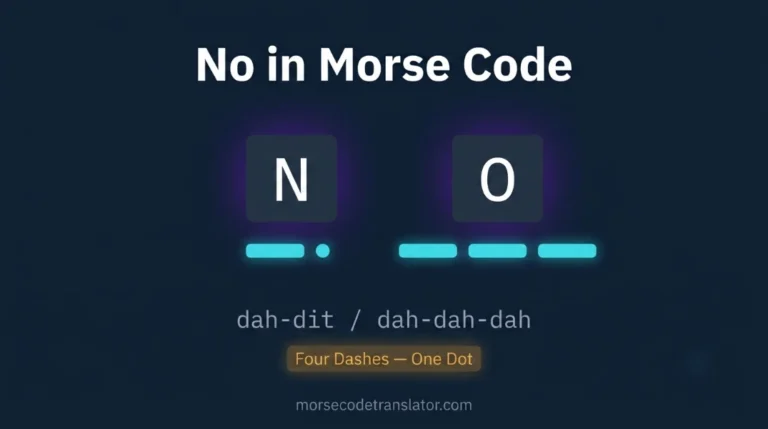
— . | N | Dah then dit |
— — | M | Two dahs |
. . . | S | Three dits |
— — — | O | Three dahs |
. — . . | L | Dit dah dit dit |
. . . — | V | Three dits one dah |
. . . . | H | Four dits |
. . . — — — . . . | SOS | Universal distress prosign |
How Morse Code Decoding Works — The System Behind the Dots
Understanding the decoding system helps you catch formatting errors and get accurate results every time.
The dots and dashes define each character. The silence between them defines where one character ends and the next begins. This is the principle that Alfred Vail and Samuel Morse built the system on in the 1830s alongside the electric telegraph.
Without correct spacing, the sequence . . . could be the letter S or three separate E’s. The spacing tells the decoder which one you mean. The ITU-R M.1677-1 standard defines these timing ratios:
Element | Duration | Text Representation |
Dit (dot) | 1 unit | . |
Dah (dash) | 3 units | — |
Gap between symbols in one letter | 1 unit | no space between . and — |
Gap between letters | 3 units | single space |
Gap between words | 7 units | forward slash or double space |
Alfred Vail studied letter frequency in a Philadelphia newspaper’s type cases and assigned the shortest codes to the most common letters. E became a single dit. T became a single dah. This frequency-based design is why decoding feels natural once you learn the common letters first — E and T appear in almost every English word.
How to Decode Morse Code by Ear — No Tool Required
Decoding morse code by ear is a real skill. Once you build it, you never need a tool again. You hear the tones and understand the message directly.
Morse operators in the early telegraph era discovered they could translate the sound of the receiver clicking instead of reading paper tape. They learned the sound patterns of each letter as complete audio units. This made the paper tape unnecessary and dramatically increased decoding speed.
Here is how to build that skill.
Use vocal names for every symbol
Professional CW operators never say dot and dash. They say dit and dah. The words mimic the actual tone sounds. Practicing with these names locks each pattern into memory faster than visual study alone.
Attach rhythm phrases to each letter
Each letter has a natural spoken rhythm that matches its dit-dah pattern. Some examples:
Letter | Pattern | Rhythm Phrase |
C | — . — . | “COPY that, COPY that” |
Q | — — . — | “God SAVE the Queen” |
V | . . . — | Beethoven’s Fifth opening |
Y | — . — — | “WHY did you GO there” |
Once a rhythm phrase connects to a letter, your brain retrieves it instantly. Pattern recognition takes over.
Practice with the Koch method at Farnsworth speed
The Koch method starts with two letters at full speed. You practice until you reach 90 percent accuracy, then add one letter at a time without slowing down. Farnsworth timing stretches the gaps between letters while keeping each character at full speed. Your brain hears the correct sound pattern while the spacing gives you time to respond.
Set your practice speed to 15 to 20 WPM. Use the audio playback feature on this platform. Ten minutes daily produces measurable results within two weeks.
Four Decoding Mistakes That Return Wrong Results
These are the most common reasons a morse code decoder fails to return the correct output.
Running letter codes together without spaces
If you write ……-.. instead of … / .-.. the decoder reads one long unrecognised sequence instead of S then L. Every letter code needs a space after it.
Missing word separators
Without a forward slash or double space between words, the decoder reads the entire message as one continuous word. The output breaks down after the first few letters.
Pasted dashes that are not hyphens
The em dash (—) and en dash (–) look similar to a hyphen (-) but are different characters. The decoder only recognises the standard keyboard hyphen. Always check pasted content from documents or web pages.
Mixing International and American Morse Code
American Morse Code uses different patterns from the ITU International Morse Code standard. It was used on 19th-century telegraph lines in North America and is now primarily of historical interest. If you are decoding historical American telegraph messages, the patterns will not match any modern ITU-based decoder. Use International Morse Code only for this platform.
Frequently Asked Questions
Decode Any Morse Signal on This Platform
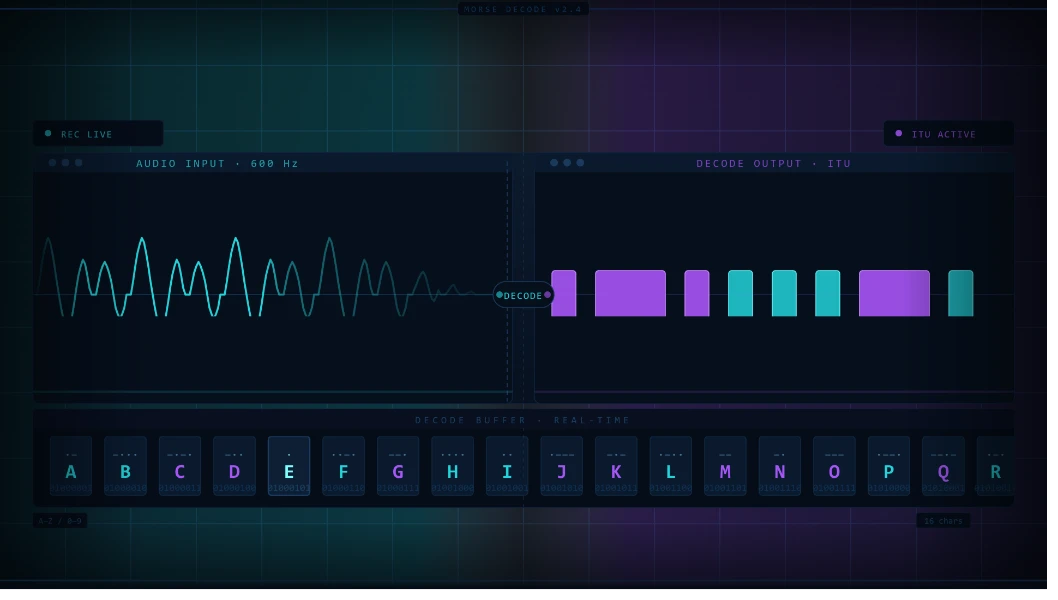
Whether you have a typed string, a recorded audio file, a photograph, or a live microphone feed, this platform handles all four. The text decoder works on formatted dot-dash strings. The audio decoder processes WAV and MP3 files. The image decoder reads morse from uploaded photos using OCR. The live mic decoder processes real-time audio signals as they play.
All four modes follow the ITU-R M.1677-1 standard. Nothing you enter or upload is stored anywhere.
To convert English text into morse code instead, use the main Morse Code Translator on the homepage.