Morse Code Alphabet — Complete A to Z Letters, Numbers and Dot-Dash Reference
The morse code alphabet is a system that maps every letter from A to Z and every number from 0 to 9 to a unique sequence of dots and dashes. No two characters share the same pattern. Every pattern has a fixed meaning recognized by operators, radio services, and communication systems worldwide.
This page gives you the complete morse code alphabet chart, the full numbers reference, individual letter lookups for the most searched characters, and a clear guide on how to read dot-dash patterns without needing to memorize every code from scratch. Every character follows the ITU-R M.1677-1 international standard, the same standard used by HAM radio operators, aviation navigation systems, and maritime communication services globally.
Use the morse code translator on our homepage to hear any letter or word played back at your chosen speed.
The Complete Morse Code Alphabet — A to Z Letters Chart
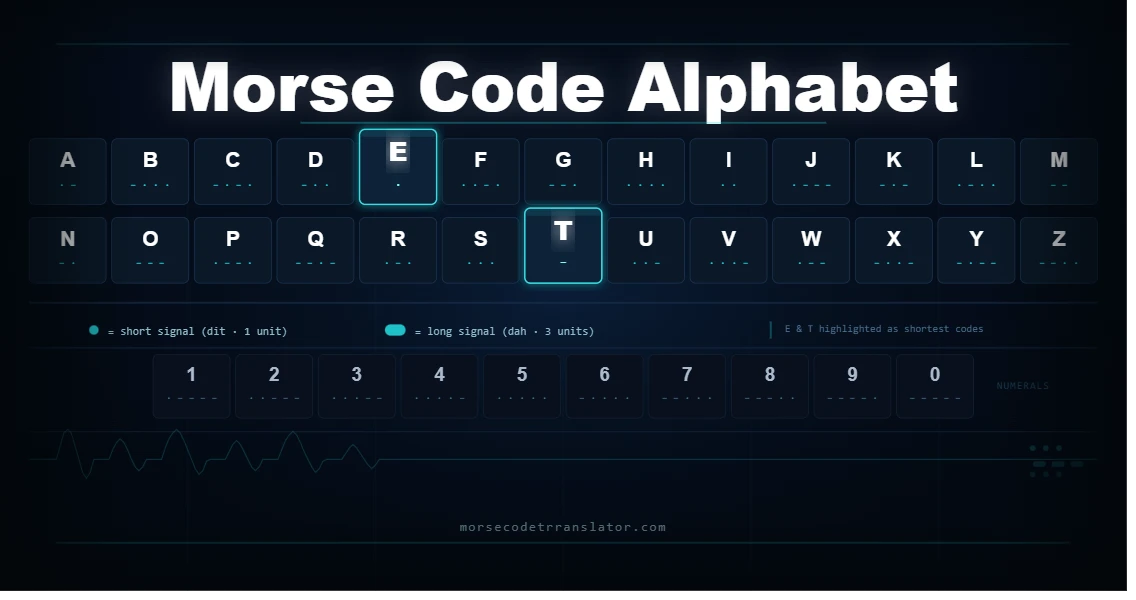
The International Morse Code alphabet was standardized by the ITU (International Telecommunication Union) under Recommendation M.1677-1. According to Wikipedia, the ITU International Morse code encodes the 26 basic Latin letters A to Z, the Indo-Arabic numerals 0 to 9, and a set of punctuation marks and procedural signals known as prosigns.
Alfred Vail, who worked alongside Samuel Morse in the 1830s, designed the letter assignments based on letter frequency. As noted by Electronics Notes, the letter E — the most commonly used letter in English — was assigned a single dot, the shortest possible code. T received a single dash. This frequency-based design keeps common English text fast to encode and transmit.
Letters A to Z — Full ITU Standard Chart
Letter | Morse | Letter | Morse |
A | . — | N | — . |
B | — . . . | O | — — — |
C | — . — . | P | . — — . |
D | — . . | Q | — — . — |
E | . | R | . — . |
F | . . — . | S | . . . |
G | — — . | T | — |
H | . . . . | U | . . — |
I | . . | V | . . . — |
J | . — — — | W | . — — |
K | — . — | X | — . . — |
L | . — . . | Y | — . — — |
M | — — | Z | — — . . |
Every letter above follows ITU-R M.1677-1 without exception. There is no distinction between upper and lower case — all characters are treated as capitals.
Morse Code Numbers — 0 to 9 Reference Chart
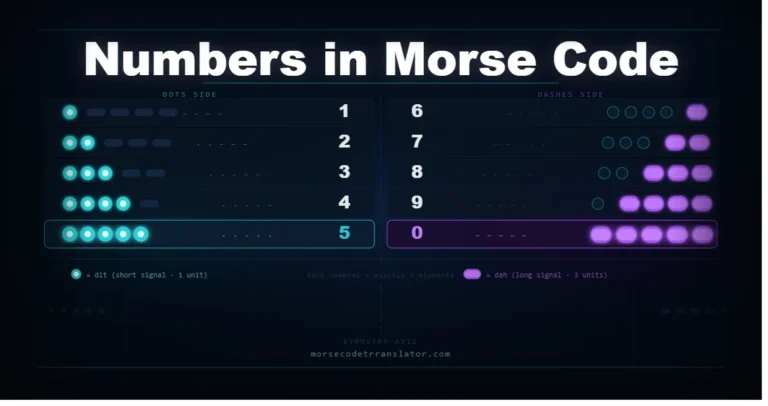
Numbers in morse code are easier to learn than letters because every number uses exactly five symbols. Numbers 1 through 5 start with dots, 6 through 9 start with dashes, and zero uses five dashes. They appear daily in HAM radio callsigns, METAR aviation weather codes, and maritime ship identifiers.
Numbers 0 to 9 — Full Reference
Number | Morse | Number | Morse |
0 | — — — — — | 5 | . . . . . |
1 | . — — — — | 6 | — . . . . |
2 | . . — — — | 7 | — — . . . |
3 | . . . — — | 8 | — — — . . |
4 | . . . . — | 9 | — — — — . |
The pattern is worth studying before memorizing. Each step from 1 to 5 adds one more dot and removes one dash until reaching 5 which is five dots. The pattern then reverses from 6 onward with dashes leading. You can work out any number from this rule alone.
Most Searched Individual Letters in Morse Code
Many people search for specific letters rather than the full chart. These are the individual letters searched most often and exactly what each one means.
What Does .-.. Mean? Common Dot-Dash Patterns Decoded
Many people search for specific dot-dash patterns rather than letters. These are the most searched patterns and what each one decodes to.
Pattern | Decoded | Notes |
. — . . (.-.. ) | L | Dit dah dit dit — four symbols |
. . . — (…-) | V | Three dits one dah — Beethoven’s Fifth rhythm |
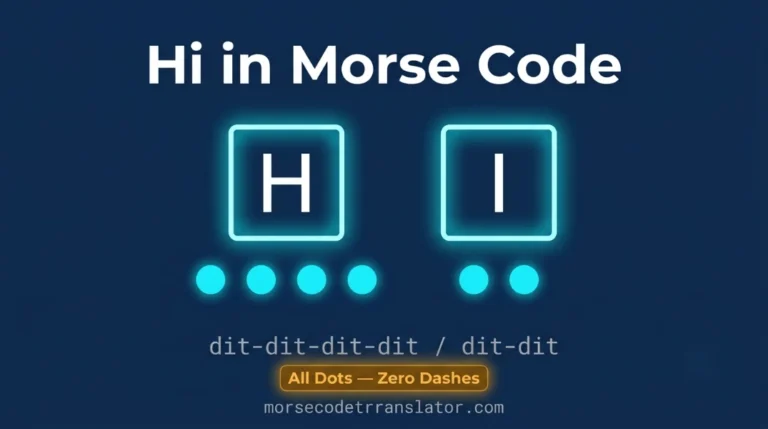
. . . . (….) | H | Four dits — not to be confused with 5 (…..) |
. . . (…) | S | Three dits — first and last part of SOS |
— — — (—) | O | Three dahs — middle part of SOS |
. (.) | E | Single dit — shortest code in the system |
— (-) | T | Single dah — second shortest |
. — (.-) | A | Dit then dah |
— . (-.) | N | Dah then dit |
— — (–) | M | Two dahs |
What does …. mean in morse code?
Four dots (. . . .) is the letter H. This is one of the most common search queries because four dots appears in several common words. Hello in morse code starts with H (. . . .) followed by E (.) — two of the first five signals you hear are the dots of H.
What does . . . mean in morse code? (dot dot dot)
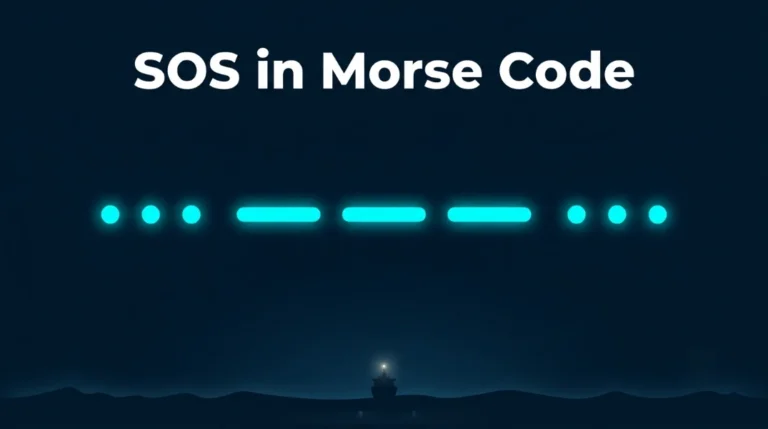
Three dots is the letter S. This is the first and last segment of the SOS distress signal (. . . — — — . . .). On its own, three dots simply means S. In live transmission, three dots transmitted at consistent dit timing is unambiguously S under the ITU standard.
What does . . . — mean? (…-)
Three dots followed by one dash is the letter V. This is the most famous morse code pattern in popular culture. Beethoven’s Fifth Symphony opens with the same rhythmic pattern — three short notes and one long note. The BBC used V as their call signal during World War II broadcasts because of this connection, making dit-dit-dit-dah one of the most recognizable sound patterns in modern history.
How to Read the Morse Code Alphabet Without Memorizing Every Letter
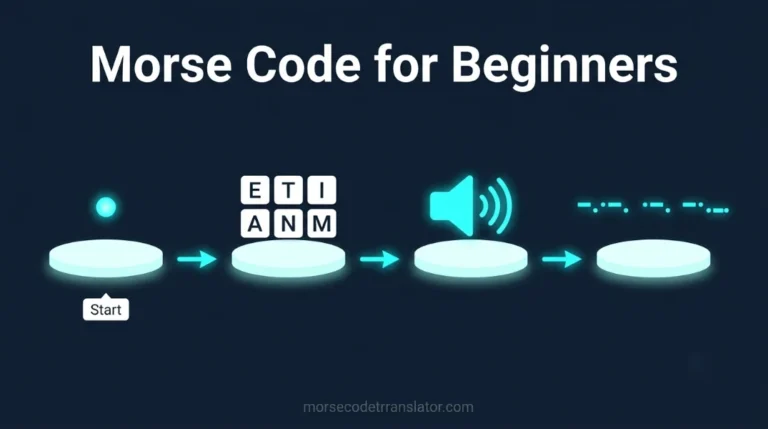
Memorizing all 26 letters at once is the slowest approach. Start with signal length. The ITU alphabet organizes by complexity — one-symbol codes, two-symbol codes, three-symbol codes, and four-symbol codes. Learn by group, not by alphabetical order.
Group | Letters | Learn These First |
1 symbol | E, T | Start here — two letters, two sounds |
2 symbols | I, A, N, M | Second — four high-frequency letters |
3 symbols | S, O, R, D, G, K, U, W | Third — builds most common short words |
4 symbols | B, C, F, H, J, L, P, Q, V, X, Y, Z | Last — add two per day |
Numbers | 0 to 9 | After letters reach 85% accuracy |
Learning by signal length builds a decision tree. One signal is E or T. Two signals is I, A, N, or M. This is exactly how the ITU code tree is organized.
The Koch method, used in licensed amateur radio training, applies this principle. Start with two letters at full speed and add one new character only after reaching 90 percent accuracy. Use the audio playback on our morse code translator at 15 to 20 WPM. Ten minutes of daily audio practice produces measurable results within two weeks.
Frequently Asked Questions
Use the Alphabet Morse Code Translator to Hear Every Letter
Every letter and pattern on this page comes to life through audio. Type any letter or word into the morse code translator on our homepage to hear it played back at your chosen WPM and pitch. Start with E and T. Build to I, A, N, and M. Add two new letters per day and use audio from the start.
For instant text encoding, visit our Convert English to Morse Code guide.