How to Read Morse Code — A Complete Guide to Morse Code Language and Meaning
Morse code looks complicated at first. A string of dots and dashes feels like noise until you understand the system behind it. Once you do, it clicks fast.
Reading morse code means recognizing sequences of short signals (dits) and long signals (dahs) as letters, numbers, and words. With the right method — starting with rhythm rather than memorization — most beginners decode their first words within an hour.
This guide covers what morse code means, how the language works, how to read and write it, how to say common phrases, what the end signal means, and which tools make the process faster. Every example follows the ITU-R M.1677-1 standard.
What Does Morse Code Mean — The Morse Code Language Explained
Morse code is a telecommunications method that encodes text characters as standardized sequences of two different signal durations called dots and dashes. According to Merriam-Webster, morse code consists of variously spaced dots and dashes or long and short sounds used for transmitting messages by audible or visual signals.
The system works on a simple on-off principle. A signal is either present or absent. Short presence is a dit. Long presence is a dah. Silence between signals carries as much meaning as the signals themselves. This binary structure is why morse code is sometimes called the world’s first digital language — it predates binary computing by over a century.
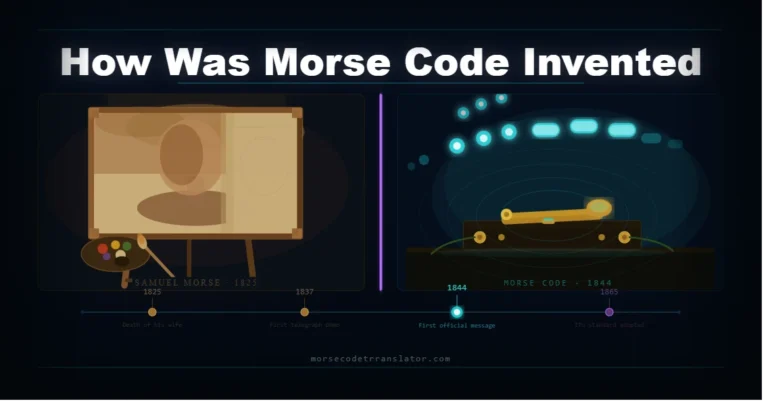
According to Britannica, the International Morse Code became the global standard after a European conference in 1851 revised the original American system. The ITU later formalized it under Recommendation M.1677-1, the definitive reference for every character in use today.
Morse code meaning goes beyond dots and dashes. It is a complete communication language built on timing, precision, and pattern recognition — transmittable through sound, light, radio waves, or physical taps.
How to Translate Morse Code — Reading the Dot-Dash System
Translating morse code starts with understanding its two building blocks and then the spacing rules that hold them together.
The two signals:
The four spacing rules:
These rules come directly from ITU-R M.1677-1. At 15 WPM, one unit lasts 80 milliseconds and every other timing value scales from that number. Getting the spacing right is what separates readable morse code from gibberish.
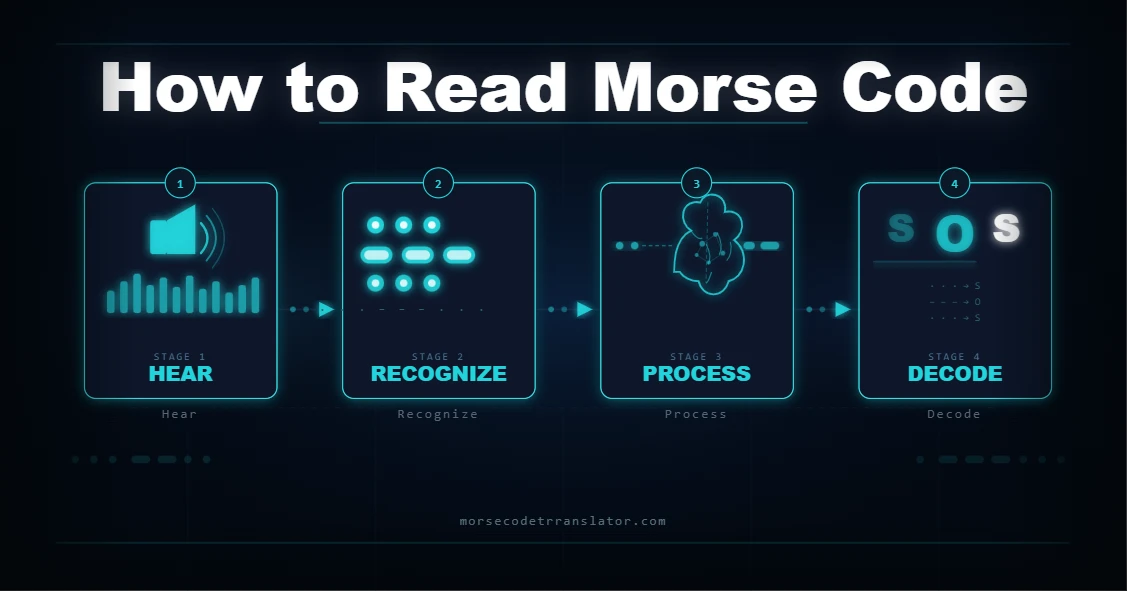
How to decode a morse code string step by step:
Here is a worked example: …. . .-.. .-.. — decodes as H-E-L-L-O which spells HELLO.
Morse Code Guide — How to Read Morse Code by Ear
Reading morse code visually from a chart is one skill. Reading it by ear from audio is a completely different and more powerful one. Professional CW (continuous wave) operators read morse code entirely by sound — no chart, no screen, no writing.
According to Military.com, skilled telegraph operators could transmit and receive morse code messages at up to 84 words per minute, with 30 to 35 WPM being the average for experienced operators. That speed is only possible through sound-based pattern recognition, not visual decoding.
The key method used by every expert is the Farnsworth timing approach, named after amateur radio operator Donald R. Farnsworth (W6TTB). Each character plays at full target speed while the gaps between characters are extended. Your brain hears the complete sound of each letter correctly while the spacing gives you time to respond.
Practical steps for learning to read morse code by ear:
The Koch method pairs Farnsworth timing with strict character progression. You start with two letters and add one new character only after reaching 90 percent accuracy. According to a training method by W0UCE archived on Scribd, most students reach 25 to 30 WPM proficiency within 60 days of daily practice.
Writing in Morse Code — The Correct Format for Text-Based Messages
Writing in morse code means converting English text into correctly formatted dot-dash patterns that any decoder or trained reader can interpret without errors.
The rules for writing morse code correctly:
Google integrated morse code input directly into its Gboard keyboard for Android in 2018, making texting in morse code possible using just two keys on any smartphone. Writing morse code for personal messages, jewelry engravings, or tattoos follows the same formatting rules. Use our morse code translator on the homepage to convert any phrase instantly.
How to Say Hello and Help in Morse Code
Specific phrase conversions are among the most searched morse code questions online. Here are the most common ones with their exact ITU encodings.
How to say hello in morse code:
Hello encodes letter by letter as …. . .-.. .-.. —
Letter | Morse |
H | . . . . |
E | . |
L | . — . . |
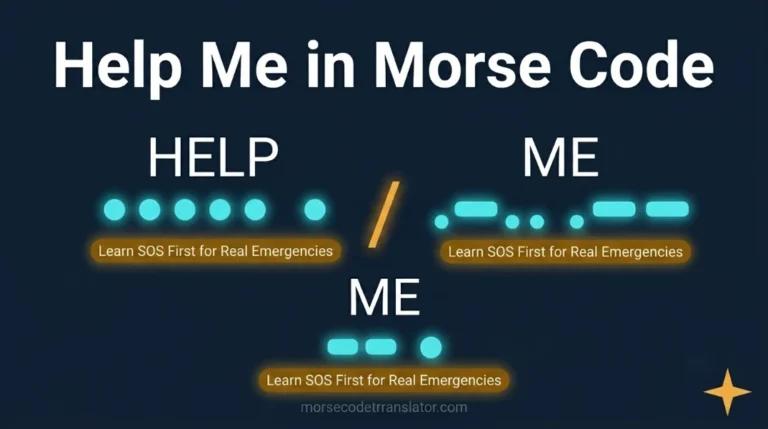
How to say help in morse code:
Help encodes as …. . .-.. .–.
Letter | Morse |
H | . . . . |
E | . |
L | . — . . |
P | . — — . |
Other common phrases:
Phrase | Morse Code |
Hi | . . . . / . . |
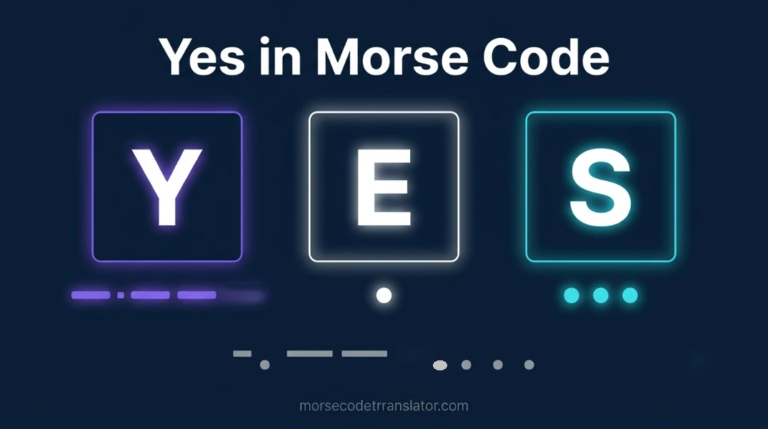
Yes | — . — — / . / . . . |
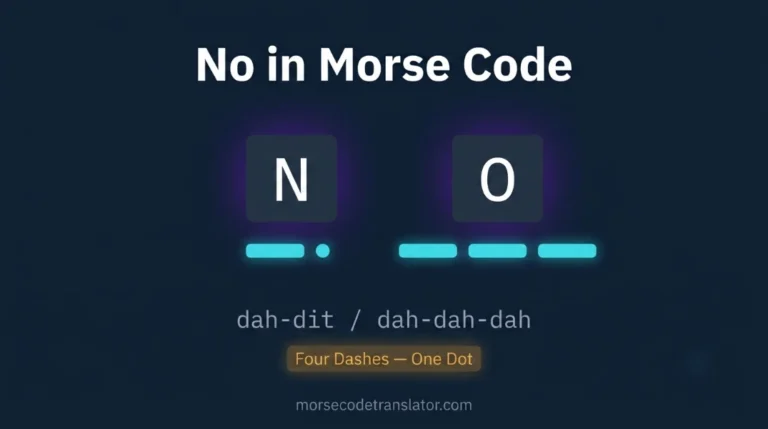
No | — . / — — — |
SOS | . . . — — — . . . |
I love you | . . / . — . . / — — — / . . . — . / — . — — / — — — / . . — |
Thank you | — / . . . . / . — / — . / — — — / . — . — . — / — . — — / — — — / . . — |
What Is the End Signal in Morse Code
The end signal in morse code is a prosign — a procedural signal that carries operational meaning beyond standard letters. Prosigns are sent as two letters with no gap between them.
The most important end signals used in CW operation include:
Prosign | Meaning |
AR | End of message — over |
SK | End of contact — clear |
BT | Break — new paragraph |
KN | Go ahead — specific station only |
K | Go ahead — any station |
According to Wikipedia’s article on Prosigns for Morse Code, AR is the official end-of-transmission signal. It tells the receiving operator that the current message is complete. SK is used at the very end of a contact to signal that the operator is closing down entirely. Both are recognized by every ITU-compliant operator worldwide.
When someone asks what the end signal in morse code is, the answer depends on context. AR ends a message. SK ends a full conversation. Both are distinct from regular letters because they transmit as a single unbroken signal block with no inter-character gap.
Morse Code Tools — What You Need to Read and Translate Morse Code
Here is what each morse code tool is best for and when to use it.
Tool | Best Used For |
Morse code translator | Converting typed text to morse and morse to English instantly |
Audio playback with WPM control | Training your ear to recognize letter sounds at target speed |
Pasting a dot-dash string and getting English text back | |
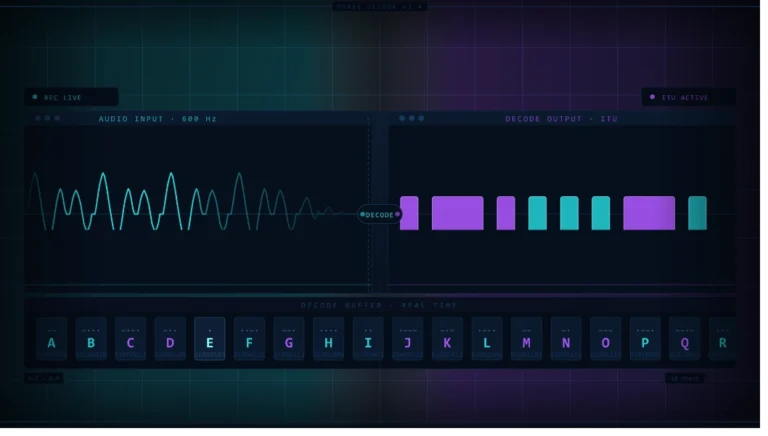
Live microphone decoder | Decoding real-time audio signals or tap input |
Audio file decoder | Uploading WAV or MP3 recordings for automatic decoding |
ITU reference chart | Looking up any letter, number, or symbol during practice |
Testing your recognition speed with decode and encode rounds |
All tools are available on this platform. Start with the translator to see how any phrase looks in morse code in english. Move to audio playback to hear it at 15 WPM. Use the quiz daily to build recognition speed and track your weak spots.
Frequently Asked Questions
Start Reading Morse Code with the Right Tools Today
How to read morse code comes down to one principle: start with sound, learn by rhythm, and practice ten minutes every day. The ITU-R M.1677-1 standard gives every pattern exactly one meaning with no exceptions.
Use the translator on this platform for instant conversion. Use audio playback to train your ear. Use the quiz to test your speed. Visit our Morse Code Alphabet page for the complete A to Z chart, or our Convert English to Morse Code guide for common phrase conversions.