How Was Morse Code Invented — Origin, Inventors and the Story Behind Every Dot and Dash
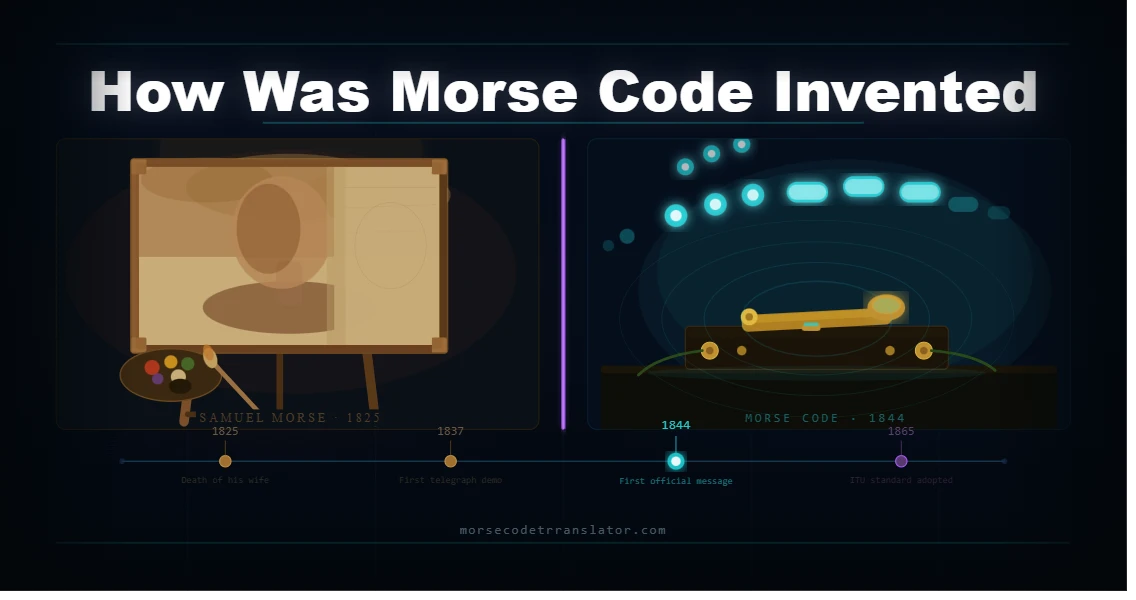
Morse code did not begin in a laboratory. It began with grief.
In 1825, Samuel Morse was in Washington D.C. when a letter arrived — his wife had fallen ill. By the time he reached home in New Haven, Connecticut, she was already buried.
That loss drove Morse to spend the next two decades building a system that would prevent such delays forever. This is the full story of how morse code was invented, who actually built it, and how it became the global standard still used in every HAM radio transmission and aviation beacon today.
The World Before Morse Code
Before the electric telegraph, information traveled at the speed of a horse.
Visual semaphore systems relayed flag signals across hilltops but required clear line of sight and failed at night.
According to the Library of Congress, the young American republic offered a prize of $30,000 for a workable long-distance communication solution. Several inventors across Europe and America were racing toward it simultaneously.
The Scientists Morse Could Not Have Succeeded Without
Samuel Morse is the name history remembers. But three others made his work possible.
Scientist | Year | Contribution |
Hans Christian Ørsted | 1820 | Discovered electromagnetism — the foundation of all telegraph technology |
Joseph Henry | 1831 | Built a working telegraph at Princeton and invented the relay system |
Leonard Gale | 1836 | NYU chemistry professor who fixed Morse’s signal strength problems |
William Cooke and Charles Wheatstone | 1837 | British five-needle telegraph — already in use for railway signaling |
Joseph Henry’s relay system was the critical breakthrough. According to the Library of Congress, when Morse encountered signal loss over long distances, Gale pointed him toward Henry’s published solution.
Morse was also aware of Cooke and Wheatstone’s British system. He was determined to beat it with a simpler, single-wire design.
Samuel Morse — The Painter Who Became a Pioneer
Samuel Finley Breese Morse was born in Charlestown, Massachusetts on April 27, 1791.
He spent the first four decades of his life as a professional painter. His wife’s death in 1825 changed everything.
In 1832, on a ship returning from Europe, Morse overheard a conversation about Michael Faraday’s electromagnet. The idea struck him immediately:
If electricity can travel through a wire at lightning speed — why not attach a message to it?
Back in New York, he began building with crude materials:
According to the Smithsonian Magazine, that original prototype is now part of the Smithsonian’s collections — a physical artifact showing the exact moment a painter became an inventor.
By 1837, Morse had a working model. He demonstrated it at New York University on September 2, 1837, in front of a small audience. One of those spectators was a 29-year-old engineer named Alfred Vail.
That meeting changed everything.
Alfred Vail — The Unsung Inventor Behind the Code
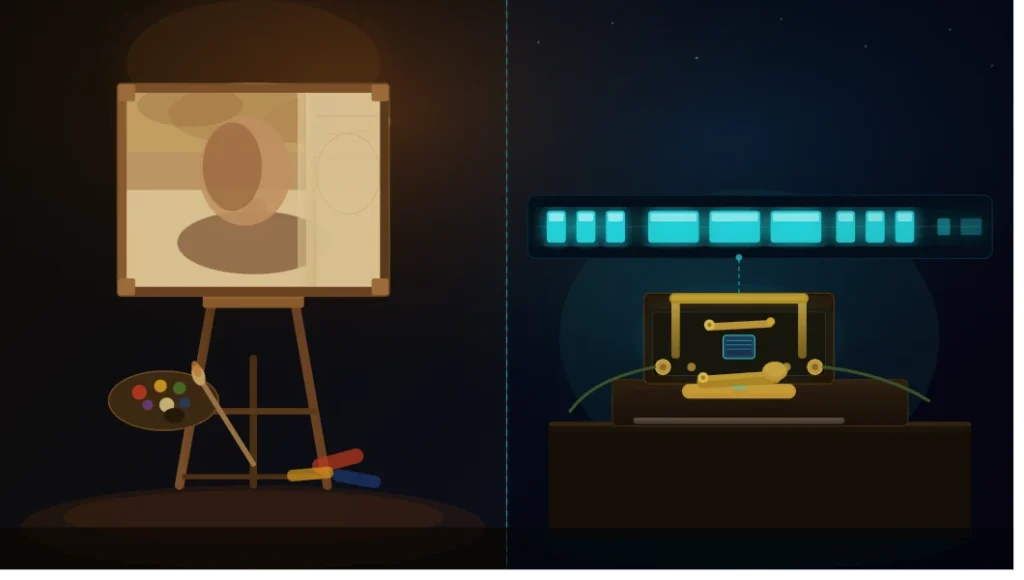
History credits Morse. But the dot-dash letter assignments we use today were largely the work of Alfred Vail.
The Problem With Morse’s Original System
Morse’s first design was built around numbers. Each number corresponded to a word in a separate codebook. To send one word, an operator had to:
Slow. Impractical. Required codebooks everywhere.
Vail’s Solution
Vail redesigned the system so dots and dashes represented letters directly — no codebook needed.
To assign the shortest codes to the most common letters, Vail went to the newspaper office in Morristown, New Jersey and counted the movable type in the printer’s cases. According to Wikipedia:
This is the frequency-weighted encoding that still powers the morse code alphabet used worldwide today.
What Else Vail Contributed
According to the Smithsonian Institution Archives, Vail’s papers document his contributions in full — yet Morse’s name appeared on the patents. Vail’s role was largely erased from history.
The First Public Demonstration — January 6, 1838
Morse, Gale, and Vail packed over two miles of wire into a small factory building at the Speedwell Ironworks in Morristown, New Jersey.
Morse manipulated the transmitter. The receiver scratched a message onto paper tape.
The message read:
“A patient waiter is no loser.”
It was the first public demonstration of the telegraph in history. But the Panic of 1837 — an economic depression gripping the United States — had dried up investment. Morse spent years lobbying Congress while refining the system.
The First Long-Distance Message — May 24, 1844
In 1843, the U.S. Congress approved $30,000 to build a telegraph line from Washington D.C. to Baltimore, Maryland.
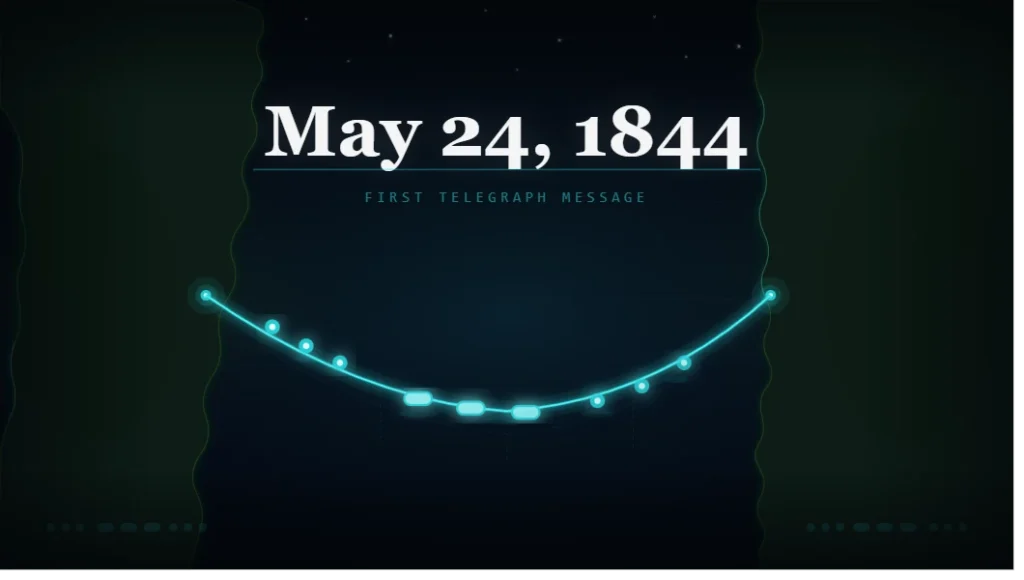
On May 24, 1844, Morse sat in the Supreme Court chamber in the U.S. Capitol. Vail waited in Baltimore at the other end of the line.
Morse transmitted a quote from the Book of Numbers — suggested by the daughter of the Commissioner of Patents:
“What hath God wrought?”
Vail received it and sent it back. The exchange took seconds.
According to History.com, by 1866 a telegraph cable had been laid across the Atlantic Ocean connecting the United States to Europe. The speed of human communication had been permanently transformed.
Friedrich Gerke and the International Standard (1848 to 1865)
Morse and Vail’s American code had inconsistencies. Different countries used their own variants. Cross-border communication was unreliable.
Friedrich Clemens Gerke, a German engineer, solved this in 1848.
His revisions:
His version became the Hamburg Alphabet, adopted across Germany and Austria in 1851.
According to Wikipedia, in 1865 the International Telegraphy Congress in Paris officially recognized the standardized version. The ITU later formalized it under Recommendation M.1677-1 — the document behind every output in our online morse code decoder and every pattern in our morse code alphabet chart.
Morse Code Through the World Wars and Into the Modern Era
Telegraph Era (1844 to 1890s) Morse code became the universal language of communication. Telegraph wires crossed continents. Undersea cables linked countries.
Radio Era (1890s onward) When radio emerged, morse code moved with it. Simple on-off CW (continuous wave) tones traveled vast distances where voice radio could not.
World War I and II Morse code became critical military infrastructure:
His version became the HamThe Titanic — April 15, 1912 Operators Jack Phillips and Harold Bride transmitted continuous SOS distress signals. The RMS Carpathia received the call and saved over 700 lives. The SOS signal had been adopted as the universal distress prosign at the Berlin Radiotelegraphic Convention in 1908 — just four years earlier.burg Alphabet, adopted across Germany and Austria in 1851.
1999 — The ITU Removes the Morse Requirement The Global Maritime Distress and Safety System (GMDSS) replaced morse code for commercial maritime communication. The French Navy sent its final morse message with the words:
“Calling all. This is our last call before our eternal silence.”
But morse code did not disappear. It simply changed audience.
How Morse Code Is Still Used Today
Morse code remains active across multiple fields:
Field | How It Is Used |
Amateur Radio (HAM) | CW bands worldwide — a 5W signal travels further than 100W voice |
Aviation | VOR and NDB beacons transmit morse identifiers — pilots still listen |
Accessibility | Google Gboard for Android supports full morse input via two tap gestures |
Emergency | SOS remains internationally recognized under maritime law |
Personal | Jewelry engravings, tattoos, and hidden messages in morse code |
Education | STEM programs use morse to teach binary logic and signal theory |
Type any word into our free morse code translator to hear the system play your message back. To test your recognition speed, try our free morse code quiz.
Frequently Asked Questions
From a Painter’s Grief to a Global Language
Morse code grew from personal tragedy, scientific collaboration, and the unrecognized genius of Alfred Vail counting letters in a New Jersey newspaper office. Morse gave it his name. Vail gave it its logic. Gerke gave it its international form. The ITU gave it permanence under Recommendation M.1677-1.
Today that system lives in every morse code translator, every HAM radio CW band, and every Google Gboard accessibility tap. The dots and dashes Vail designed in 1837 are the same ones our morse code alphabet chart displays today.