Hello in Morse Code — The Exact Pattern, Sound, Tap and Copy Guide
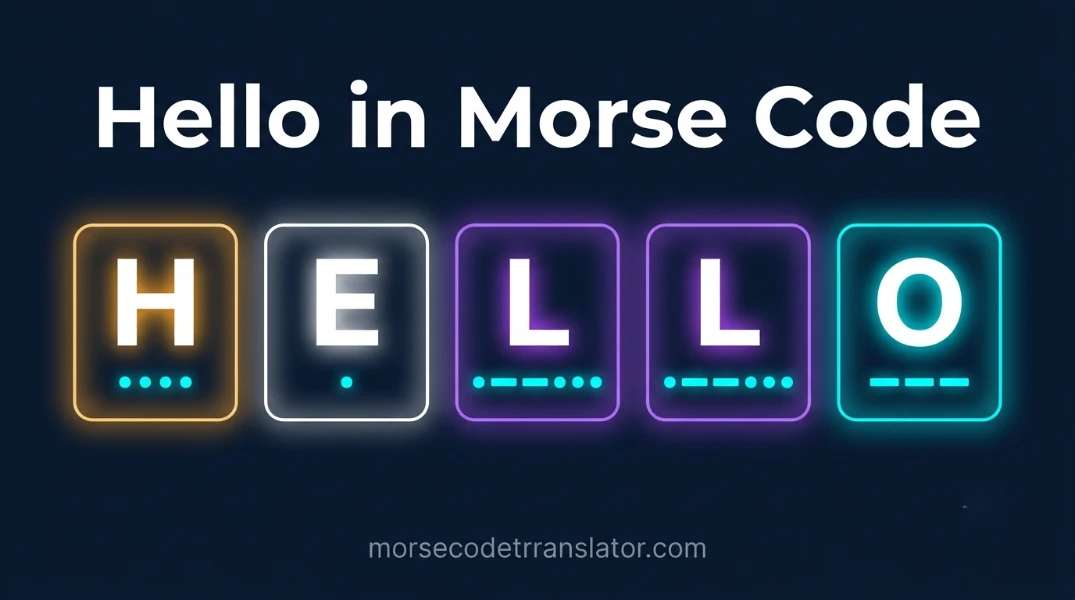
Hello in morse code is …. . .-.. .-.. —
That is five letters, 16 individual signals, and the most practiced word in morse code history. While the first telegraphic message sent by Samuel Morse in 1844 was “What hath God wrought?”, the word “Hello” quickly became one of the most transmitted words in morse code. Telegraph operators used it as their standard connection test before sending real messages. Most morse code training programs still begin with HELLO as the first complete word students learn to send.
This guide gives you the exact letter-by-letter pattern, the spoken dit-dah sequence, how to tap it, flash it, blink it, and a full comparison table of common greetings. Use the free morse code translator on this platform to hear HELLO played back at your chosen speed and pitch.
Hello in Morse Code — Letter by Letter Breakdown
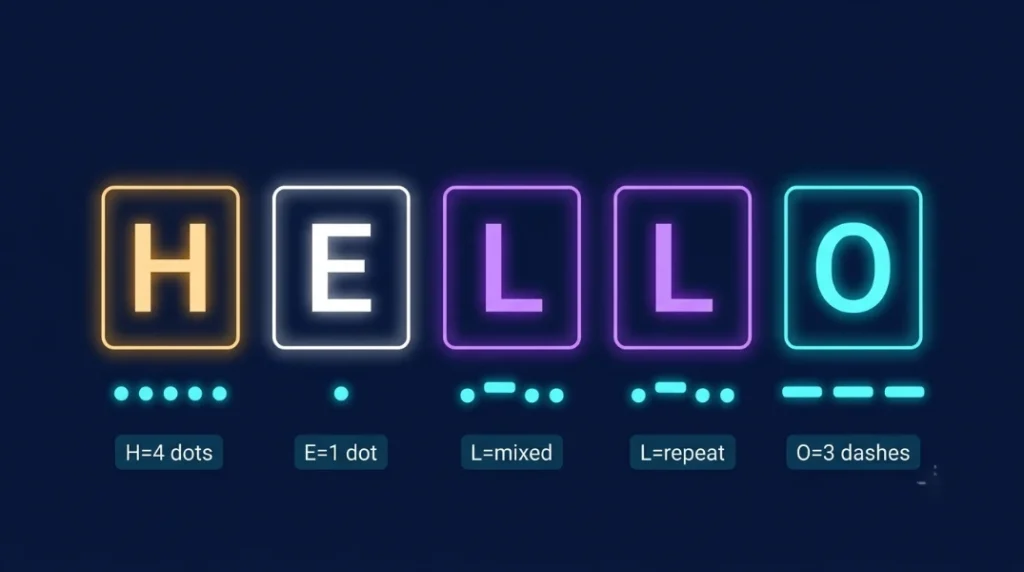
HELLO uses five letters. Each one maps to a unique dot-dash pattern in the ITU-R M.1677-1 international standard. Here is the full breakdown:
Letter | Morse Code | Signal Type | Spoken Sound |
H | . . . . | 4 dots | dit-dit-dit-dit |
E | . | 1 dot | dit |
L | . — . . | 1 dot, 1 dash, 2 dots | dit-dah-dit-dit |
L | . — . . | 1 dot, 1 dash, 2 dots | dit-dah-dit-dit |
O | — — — | 3 dashes | dah-dah-dah |
Why HELLO is the best first practice word:
HELLO in morse code has historical significance in telecommunications, being one of the first words many telegraph operators learned to send. The combination of H, E, L and O covers four very different signal patterns in a single short word.
How to Say Hello in Morse Code Out Loud
Reading morse code visually from a chart is one skill. Saying it out loud builds a completely different and faster skill — the ability to recognize letter sounds without looking at anything.
Professional CW (continuous wave) operators never say “dot” and “dash.” They say “dit” and “dah.” The words mimic the actual tone sounds. Short sharp tones are dits. Longer rolling tones are dahs.
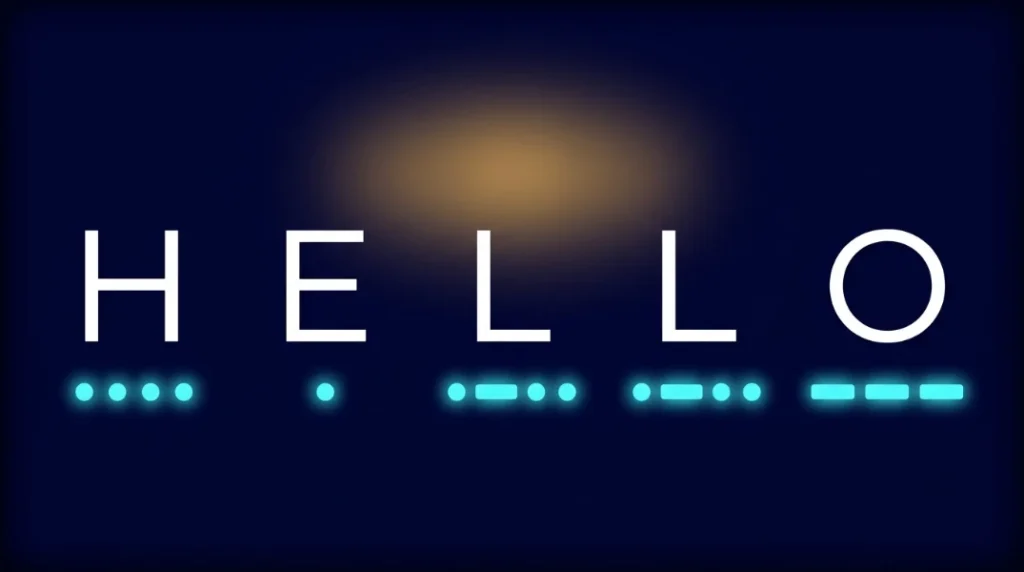
Here is exactly how to speak HELLO in morse code:
Step by step vocal sequence:
The rhythm of HELLO spoken aloud sounds like:
This vocal method is the foundation of the Koch method. According to the ARRL Handbook for Radio Communications, training your brain to hear letter sounds rather than counting individual signals is what separates beginners from confident operators.
How to Tap Hello in Morse Code
Tapping is one of the oldest ways to send morse code. Short taps are dots. Long holds are dashes. Here is the exact sequence:
Letter | Tap Pattern | Timing | |
H | tap-tap-tap-tap | Four quick taps of equal length | |
E | tap | One quick tap | |
L | tap-HOLD-tap-tap | Short tap, long hold, two short taps | |
L | tap-HOLD-tap-tap | Repeat | |
O | HOLD-HOLD-HOLD | Three long holds of equal length |
Timing rule: A short tap lasts roughly 80 milliseconds at 15 WPM. A long hold lasts three times that — about 240 milliseconds. Pause for one short tap length between signals in the same letter. Pause for three tap lengths between letters.
Consistency matters more than speed at this stage. Once you can tap HELLO cleanly ten times in a row, increase your pace by 2 WPM.
How to Flash Hello in Morse Code with a Flashlight
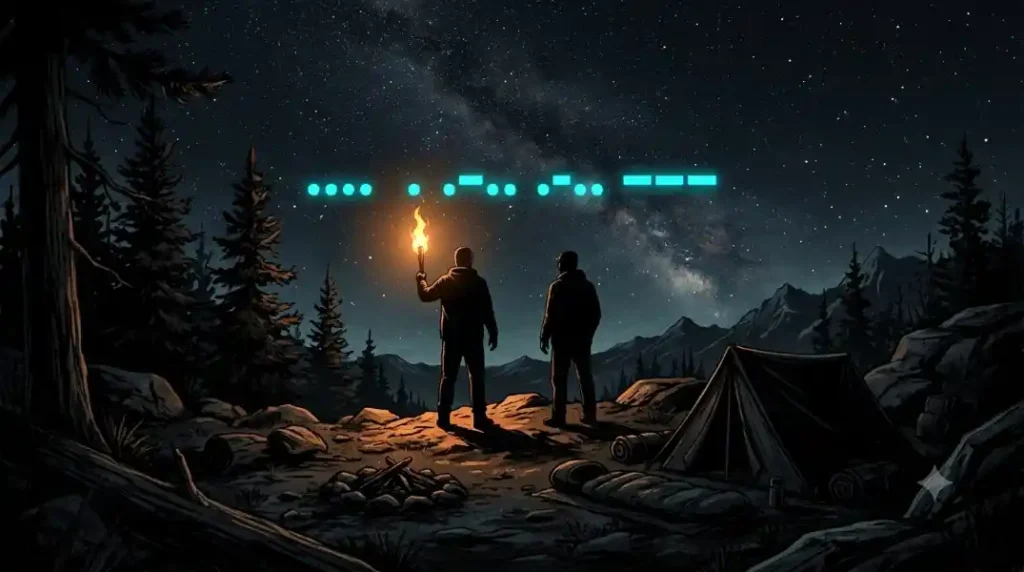
Optical signaling uses the same dot-dash patterns as sound — short flashes for dits and long flashes for dahs. The flash sequence for HELLO:
Keep short flashes under half a second and long flashes for one to one and a half seconds. This works with a phone flashlight, a torch, or any light you can switch on and off. It demonstrates exactly how morse code signaling worked on ships and in military field operations before voice radio was reliable.
How to Blink Hello in Morse Code
Blinking is the most discreet way to send morse code. No sound. No device. Just your eyes.
Short blinks are dots. Long blinks are dashes. Here is the blinking sequence for HELLO:
Letter | Blink Pattern |
H | blink-blink-blink-blink (four quick blinks) |
E | blink (one quick blink) |
L | blink-BLINK-blink-blink |
L | blink-BLINK-blink-blink |
O | BLINK-BLINK-BLINK (three slow blinks) |
Keep short blinks under half a second. Hold long blinks for one full second.
Hello vs Hi vs Other Greetings in Morse Code
HELLO is the most practiced greeting but not the only one. Here is a comparison of common greetings:
Greeting | Morse Code | Signal Count | Difficulty |
Hi | . . . . / . . | 6 signals | Very easy — all dots |
Hello | . . . . / . / . — . . / . — . . / — — — | 16 signals | Beginner — 5 letters |
Hey | . . . . / . / — . — — | 10 signals | Easy — 3 letters |
Good morning | — — . / — — — / — . . / — — — — — / — — / — — — / . — . / — . / . . / — . / — — . | 50+ signals | Intermediate |
How are you | . . . . / — — — / . — — / . — . / . / — . — — / — — — / . . — | 30+ signals | Intermediate |
Start with Hi (. . . . / . .) — all dots, no dashes, the simplest introduction to morse rhythm. Once Hi feels natural, move to Hello.
Why HELLO Is the Perfect First Word to Learn in Morse Code
HELLO gives you a better approach than learning the alphabet letter by letter. Its five letters teach H (the longest dot pattern), E (the shortest signal in the system), L (the first mixed pattern), L again (immediate repetition for muscle memory), and O (the first all-dash sequence). According to inmorsecode.com, HELLO remains the standard first word in beginner morse training because its five letters cover the widest range of signal types in the fewest characters.
Once you can send HELLO cleanly by tapping, flashing, or speaking, you have learned the mechanics of every other word in morse code. The patterns change. The system never does.
Frequently Asked Questions
Hear Hello in Morse Code Right Now
Hello in morse code is …. . .-.. .-.. — and it remains the most practiced greeting in morse code since telegraph operators first used it to test connections in the 1800s.
Type HELLO into the free morse code translator above. Hit Play Audio to hear the ITU-R M.1677-1 tones at your chosen WPM and pitch. For more greetings and phrases, visit our Convert English to Morse Code guide. To decode any message sent back to you, visit our Online Morse Code Decoder. For the full letter reference, visit our Morse Code Alphabet chart.