Y in Morse Code — The Complete Pattern, Sound and Memory Guide
Y in morse code is — . — —
Four signals. One dash, one dot, two dashes. Spoken out loud it sounds like dah-dit-dah-dah — one of the most dramatic rhythms in the entire ITU morse code alphabet.
This guide gives you the exact pattern for the letter Y in morse code, how to write it, say it, tap it, and remember it. It also covers ILY in morse code, confused letters, and real-world use cases. Every pattern follows the ITU-R M.1677-1 standard.
What Is Y in Morse Code — The Exact Pattern
Y in morse code uses four signals in a specific sequence.
Detail | Value |
Letter | Y |
Morse Code | — . — — |
Signal Count | 4 signals |
Spoken Sound | dah-dit-dah-dah |
Signal Type | Mixed — dashes and dot |
ITU Standard | ITU-R M.1677-1 |
Copy and paste format: -.–
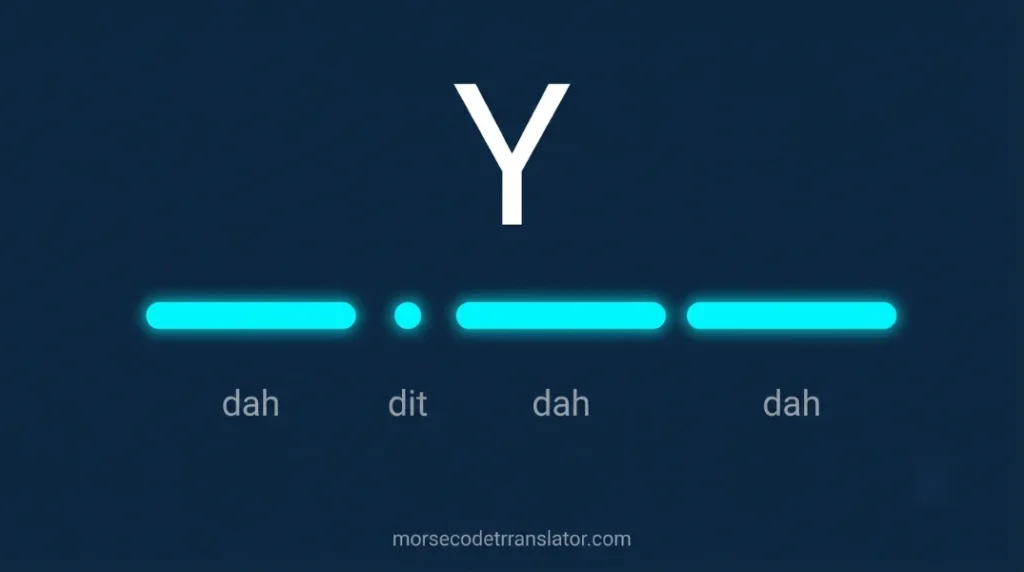
Full breakdown signal by signal:
The single dot in the middle is what makes Y distinctive. Three of its four signals are dashes — but the lone dot sits in position two, breaking the all-dash pattern and making Y immediately recognizable once you know it.
How to Write Y in Morse Code — Four Methods
Method 1 — On Paper
Write Y as: — . — —
Use a long dash for each dah and a small dot for the dit. Leave a small gap between signals and a larger gap before the next letter. This is the ITU-R M.1677-1 standard format used in written morse transcription.
Method 2 — How to Say Y in Morse Code Out Loud
Say: dah-dit-dah-dah
The spoken method is what professional CW (continuous wave) operators use. Short sharp sounds are dits. Longer rolling sounds are dahs. The natural rhythm of dah-dit-dah-dah has a distinctive pulse — long, short, long, long — that stands out clearly from every other four-signal letter.
Method 3 — How to Tap Y in Morse Code
Signal | Tap Type | Duration at 15 WPM |
— (dah) | Long hold | ~240 milliseconds |
. (dit) | Short tap | ~80 milliseconds |
— (dah) | Long hold | ~240 milliseconds |
— (dah) | Long hold | ~240 milliseconds |
Tap on any hard surface. Long holds for dashes. Short taps for the dot. Pause 80 milliseconds between signals within the letter and 240 milliseconds before the next letter begins.
Method 4 — With Light or Blink
Flash sequence for Y: long-short-long-long
This works with a torch, phone flashlight, or eye blinks. The same pattern used in optical signaling since the early 20th century follows the exact same ITU timing ratios.
The Best Memory Trick for Y in Morse Code
Most beginners struggle with Y because it mixes three dashes and one dot. Here is the trick that makes it stick.
The “WHY did you GO there” rhythm phrase:
Say: WHY-did-you-GO
Say “WHY-did-you-GO” out loud right now. That exact rhythm is Y in morse code. Your brain attaches the letter Y to the question word WHY — the same letter. This creates two memory anchors at once: the sound pattern and the word association.
According to the ARRL Handbook for Radio Communications, rhythm-based mnemonic phrases are the fastest way to internalize morse code letters. Y is one of the hardest four-signal letters to learn without a phrase — and one of the easiest with one.
Do Not Confuse Y With These Letters
Y shares signal characteristics with three other letters. Knowing the differences from the start prevents the most common beginner errors.
Letter | Morse Code | How It Differs from Y |
Y | — . — — | Dash, dot, dash, dash |
Q | — — . — | Dash, dash, dot, dash — dot is in position 3 not 2 |
C | — . — . | Dash, dot, dash, dot — ends in a dot not a dash |
X | — . . — | Dash, dot, dot, dash — two dots in the middle |
The easiest way to keep them apart:
Practicing Y, Q, C, and X together in a short drill session eliminates confusion faster than studying them separately.
ILY in Morse Code — I Love You Starting with Y
Many people search for ILY in morse code, which stands for I Love You — a common shorthand used in personal messages, tattoos, and jewelry engravings.
ILY in morse code:
Letter | Morse Code |
I | . . |
L | . — . . |
Y | — . — — |
Full pattern: .. .-.. -.–
The Y in ILY is the most complex letter of the three. I is two dots. L is dot-dash-dot-dot. Y closes the sequence with its dramatic dah-dit-dah-dah pattern. Together, ILY in morse code produces a clean three-letter string that works well for bracelet engravings and tattoo designs.
For the full I love you pattern with all three words spelled out, visit our I love you in morse code guide.
Y in Morse Code — Real-World Use Cases
Y appears constantly in real morse code communication. Here is where you encounter it most often.
HAM Radio Call Signs
Y appears in many international amateur radio call sign prefixes. According to the ITU International Amateur Radio Union, call sign prefixes are assigned by nation and must be transmitted correctly in CW — making Y fluency essential for international contacts.
The Q-Code QSY
QSY means “change frequency to” and is one of the most used Q-codes in amateur and maritime radio. Y appears as the final letter. According to Wikipedia’s article on Q-codes, QSY is transmitted dozens of times during any active amateur radio contest.
CW Contesting
In CW contesting, Y appears in YES and YOUR. According to the RSGB, contest-grade operators work at 25 to 35 WPM — speed where Y must be recognized as a complete sound instantly.
Frequently Asked Questions
Learn the Letter Y in Morse Code Right Now
Y in morse code is — . — — and it is one of the most recognizable letters in the ITU-R M.1677-1 standard once you hear its dah-dit-dah-dah rhythm pattern.
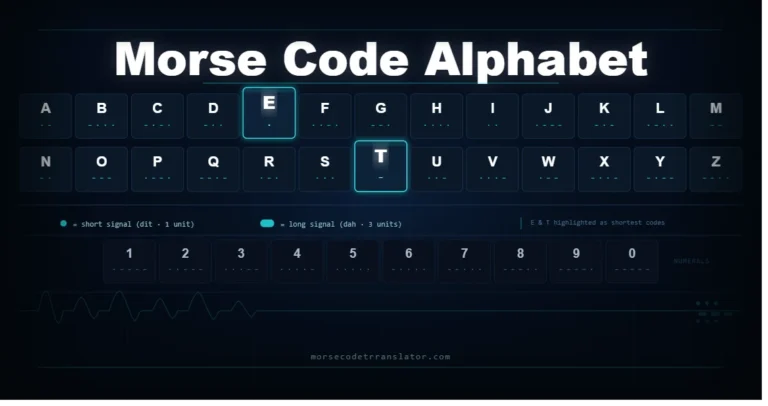
Type Y into the free morse code translator on this platform to hear it played back at your chosen WPM and pitch. Use the audio at 15 WPM to train recognition, not counting. Practice the WHY-did-you-GO rhythm phrase until Y becomes instant.
For the complete A to Z reference, visit our morse code alphabet chart. For learning all letters in the right order, visit our morse code for beginners guide. To decode any morse message containing Y, use our online morse code decoder.