Hi in Morse Code | How to Tap, Blink, Flash and Say It
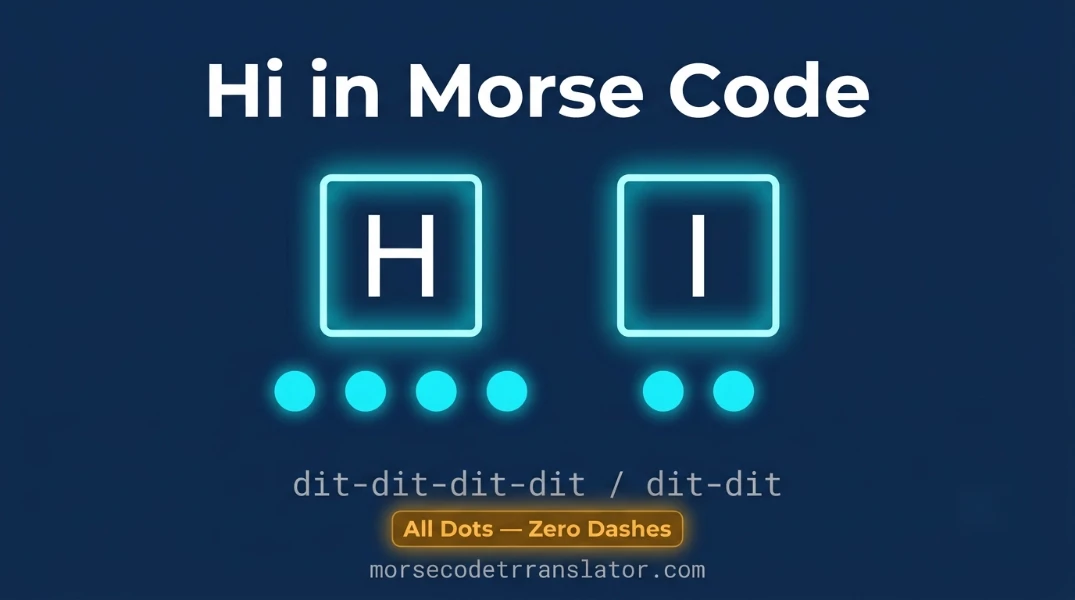
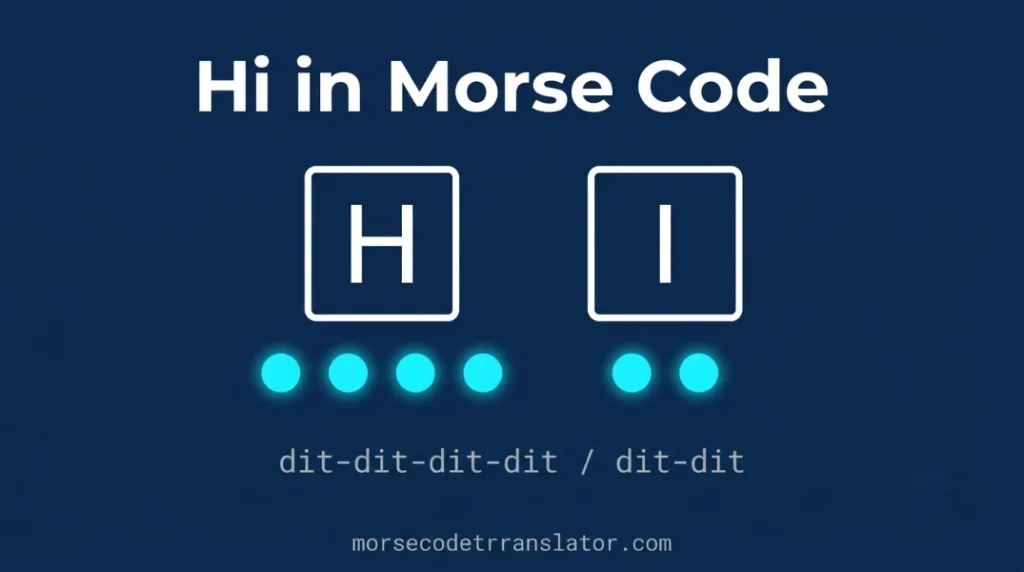
Hi in morse code is …. .. — four dots for H and two dots for I. Six signals total, zero dashes anywhere in the word.
That is exactly why HI is the most recommended first word for anyone learning morse code. Both letters use only dots — no dashes, no mixed patterns, just six clean even taps, flashes, or blinks in a row. Most people learn and transmit HI within five minutes of seeing it.
This guide gives you the exact pattern, how to tap it, flash it, blink it, say it out loud, type it in Roblox, and how to encode hi how are you in morse code. Every pattern follows the ITU-R M.1677-1 standard.
What Is Hi in Morse Code — The Exact Pattern
Hi uses two letters: H and I. Both are dot-only codes in the ITU-R M.1677-1 standard.
Letter | Morse Code | Signal Type | Spoken Sound |
H | . . . . | 4 dots | dit-dit-dit-dit |
I | . . | 2 dots | dit-dit |
Full word — hi in morse code dots format: . . . . / . .
Hi in morse code copy and paste: …. ..
Spoken out loud: dit-dit-dit-dit / dit-dit
Total signal count: 6 dots across 2 letters — zero dashes
Why HI is the best first word in morse code:
According to ARRL training documentation, learning all-dot words first is the fastest way to build the timing muscle memory every other morse code letter depends on.
How to Say Hi in Morse Code Out Loud
Saying morse code out loud builds ear recognition faster than reading charts.
Professional CW (continuous wave) operators say dit for every dot and never say dot. The word dit sounds exactly like the actual tone — short and sharp. For HI, the full spoken sequence is:
dit-dit-dit-dit (pause) dit-dit
The pause between the two words represents the letter gap — three units of silence between H and I. At a comfortable beginner pace, that pause lasts about 240 milliseconds. Say the whole thing as one smooth rhythm: dit-dit-dit-dit, pause, dit-dit.
How to Tap Hi in Morse Code
Tapping is the oldest and most direct way to send morse code. You need no equipment — just a finger and any hard surface.
Short taps are dots. Here is the exact tapping sequence for HI:
Letter | Tap Pattern | Signal Count |
H | tap-tap-tap-tap | 4 quick taps |
(gap) | pause | 3 tap-lengths of silence |
I | tap-tap | 2 quick taps |
How to tap hi in morse code at 15 WPM:
The gap between letters is the one thing most beginners get wrong. Without a clear pause between H and I, the six dots blur into one unrecognizable string. The letter gap — three tap-lengths of silence — is what separates a message from noise.
How to say hi in morse code tapping on a surface:
Tap four times quickly on a desk, phone, or wall. Pause for one full beat. Tap twice. The receiver hears four-pause-two and decodes HI instantly.
How to Flash Hi in Morse Code with a Light
Light signaling uses the same dot-dash system as sound — short flashes for dots and long flashes for dashes. Since HI uses only dots, every flash is a short flash.
How to say hi in morse code light:
Keep every flash under half a second. Pause for one flash-length between signals within the same letter. Pause for three flash-lengths between H and I.
Any light source works — phone flashlight, handheld torch, signal mirror, or Aldis lamp (the naval signal lamp used historically for ship-to-ship morse communication).
The Aldis lamp was developed in the early 20th century and became standard on Royal Navy vessels for visual morse communication. According to the National Museum of the Royal Navy, signal lamps were critical in situations where radio silence was required. HI was a common test pattern used by operators to verify equipment function before sending real messages.
How to Blink Hi in Morse Code
Blinking is the most discreet method — no sound, no device, no movement except your eyes.
Short blinks are dots. Long blinks are dashes. Since HI is all dots, every blink is a short blink.
How to blink hi in morse code:
Keep short blinks under half a second. Pause for three blink-lengths between letters. This method is the same technique U.S. Navy Commander Jeremiah Denton used in 1966 when he blinked TORTURE in morse code during a televised interview while a prisoner of war in North Vietnam. According to Military.com, his captors had no idea he was sending a message to American intelligence.
Hi in Morse Code Roblox — How to Use It
Roblox players use morse code in roleplay servers, military simulation games, and secret communication between friends. The in-game method is the same ITU-R M.1677-1 standard — no custom Roblox morse alphabet exists.
Hi How Are You in Morse Code
The full greeting “Hi how are you” encodes across four words. Here is each word fully spelled out:
Word | Morse Code |
Hi | …. .. |
How | …. — .– |
Are | .- .-. . |
You | -.– — ..- |
Full phrase: …. .. / …. — .– / .- .-. . / -.– — ..-
This is an intermediate phrase. Sending it cleanly at 10 WPM means you have built enough timing skill for real amateur radio practice.
Hi vs Hello vs Hey — Comparison Table
All three are common greetings but they differ significantly in morse code complexity:
Word | Morse Code | Signals | Difficulty | Letters |
Hi | …. .. | 6 | Easiest — all dots | H + I |
Hey | …. . -.– | 10 | Easy — 3 letters | H + E + Y |
Hello | …. . .-.. .-.. — | 16 | Beginner — 5 letters | H+E+L+L+O |
Hi there | …. .. / – …. . .-. . | 18 | Intermediate | 7 letters |
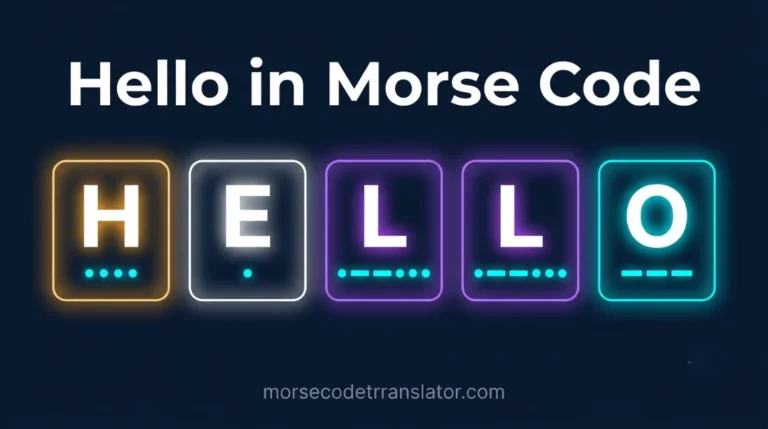
HI is the clear starting point. Once it feels natural, move to HEY — which adds Y as your first dash pattern — then to HELLO, which covers five completely different signal types.
Frequently Asked Questions
Copy Hi in Morse Code Right Now
Hi in morse code is …. .. — six dots, zero dashes, two letters, and the single easiest word in the entire morse code vocabulary.
Whether you want to tap it on someone’s hand, blink it across a dark room, flash it with a phone torch, type it in Roblox, or hear it as audio tones — the pattern is the same. Learn it once and it stays with you.
Type HI into the free morse code translator on this platform to hear it played at your chosen WPM and pitch. For the next step, visit our Hello in Morse Code guide to learn a five-letter word that covers four completely different signal types. To decode any morse message sent back to you, use our Online Morse Code Decoder.